At a glance
Complete Farming Guide from Planting to Profit Malayalam name: ഇഞ്ചി (Inchi)Botanical name: Zingiber officinale RoscoeFamily: ZingiberaceaeCrop type: Rhizomatous herb grown commercially as…
In this article
50 sections to explore
Complete Farming Guide from Planting to Profit
Malayalam name: ഇഞ്ചി (Inchi)
Botanical name: Zingiber officinale Roscoe
Family: Zingiberaceae
Crop type: Rhizomatous herb grown commercially as a seasonal crop
Main product: Fresh ginger (പച്ച ഇഞ്ചി) and dried ginger (ചുക്ക് / Chukku)
Research verified: 4 November 2026
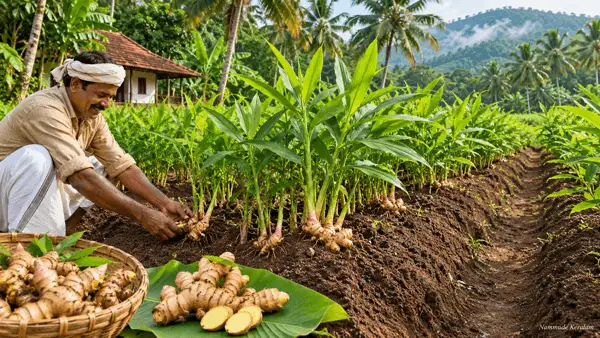
Ginger is an important spice crop in Keralam. Farmers grow it for fresh rhizomes used in cooking, dried ginger used in spice products, and planting rhizomes for the next season.
Keralam’s warm, humid climate and monsoon rainfall support ginger cultivation, particularly where the soil is rich in organic matter and drains well. However, waterlogging, infected planting material and high production costs can cause serious losses.
Ginger normally produces one commercial harvest from a planting cycle lasting approximately six to nine months. It does not behave like a fruit tree that produces a new harvest every year.
1. Where Can Ginger Grow in Keralam?
Suitable districts and regions
Ginger can be grown across Keralam wherever soil, water and drainage conditions are suitable. It performs particularly well in suitable midland and highland locations.
According to Keralam’s Agricultural Statistics 2023–24, the following districts accounted for the largest shares of the state’s reported cured-ginger production:
| District | Share of Keralam cured-ginger production, 2023–24 |
|---|---|
| Wayanad | 40.81% |
| Idukki | 19.07% |
| Pathanamthitta | 11.38% |
| Combined | 71.26% |
Other suitable areas include well-drained farms in Kannur, Palakkad, Kozhikode, Kottayam, Ernakulam, Malappuram, Thrissur, Kollam, Thiruvananthapuram and Kasaragod.
Ginger can also grow in home gardens and coconut or arecanut plantations. In low-lying areas, such as some parts of Alappuzha, drainage and water-table conditions need especially careful assessment.
These are suitability observations, not a claim that every location within a named district is suitable.
Source: Keralam Agricultural Statistics 2023–24, pages 202–203.
Climate, temperature and rainfall
| Requirement | Recommended conditions |
|---|---|
| Temperature | 19–28°C, according to ICAR–IISR’s detailed cultivation pamphlet |
| Humidity | 70–90% |
| Altitude | Sea level to approximately 1,500 metres |
| Soil pH | Ideally 6.0–6.5 |
| Soil | Fertile sandy loam, clay loam, red loam or lateritic loam |
| Sunlight | Bright growing conditions; low to moderate shade is tolerated |
| Water | Approximately 1,300–1,500 mm over the crop cycle |
| Drainage | Essential; prolonged waterlogging must be avoided |
The water figure is the published approximate crop-cycle requirement, not a minimum annual district rainfall requirement.
Ginger needs moisture for sprouting and rhizome growth. Heavy but well-distributed rainfall is beneficial during active growth, provided excess water drains away.
Dry conditions approaching harvest are desirable.
Sources: ICAR–IISR Ginger Cultivation, pages 1 and 5; KAU Package of Practices.
Is sunlight necessary?
Ginger tolerates low to moderate shade. This makes it suitable for planting between coconut and arecanut trees where enough light reaches the ground.
Extremely dense shade may reduce growth. Exposed conditions can increase leaf-spot risk in some environments.
No single Keralam-wide requirement for exact daily sunlight hours was established from the verified crop-specific recommendations.
Soil preparation matters more than district boundaries
Before investing in ginger cultivation:
- Test soil pH and nutrient levels.
- Check whether water remains standing after heavy rain.
- Avoid fields with a recent history of ginger soft rot or bacterial wilt.
- Improve drainage and organic matter before planting.
- Consider previous crops and potential soil-borne disease problems.
A small, well-drained plot can be more successful than a large field with poor drainage.
2. When Should Ginger Be Planted?
Best planting season in Keralam
Keralam Agricultural University recommends planting ginger during the first fortnight of April, after receiving pre-monsoon showers.
ICAR–IISR’s wider west-coast recommendation identifies the first fortnight of May with pre-monsoon rainfall, while also discussing earlier planting under irrigation.
These are different published recommendations, reflecting growing conditions and management systems.
| Growing situation | Published planting guidance |
|---|---|
| Keralam rainfed cultivation | First fortnight of April after pre-monsoon showers — KAU |
| Wider west-coast recommendation | First fortnight of May with pre-monsoon showers — ICAR–IISR |
| Irrigated vegetable ginger | Around mid-February — KAU |
| Other irrigated situations | Mid-February to early March — ICAR–IISR |
Farmers should choose planting dates based on actual rainfall, soil moisture, local disease history and irrigation availability.
Do not plant into dry soil simply because the calendar indicates April. Equally, avoid planting when heavy rainfall has already saturated the field.
Recommended ginger varieties
| Variety | Main use or characteristic | Published fresh yield |
|---|---|---|
| IISR Varada | Fresh ginger, dry ginger and candy | 22.6 t/ha |
| IISR Mahima | Improved variety; useful where root-knot nematodes are a problem | 23.2 t/ha |
| IISR Rejatha | Noted for essential oil content | 22.4 t/ha |
| Athira | Dual-purpose variety | 21.0 t/ha |
| Karthika | Dual-purpose variety | 19.0 t/ha |
| Aswathy | Fresh ginger and other uses | 23.0 t/ha |
| IISR Surasa | Non-pungent vegetable ginger | Up to 24.33 t/ha reported |
These are published variety trial results or stated potential, not guaranteed farm yields.
The first six yields are from ICAR–IISR’s variety table. IISR Surasa was approved by Keralam’s state varietal release committee in December 2024 and was developed specifically for vegetable use.
Traditional cultivars documented by KAU include Wayanad, Maran, Mananthody, Kuruppampady and Valluvanad, among others.
Choose a variety according to the intended market, disease history, local performance and availability of genuine planting material.
Sources: ICAR–IISR variety data; Government of India announcement on IISR Surasa.
Selecting quality planting material
Ginger is normally planted using seed rhizomes. It does not require grafted saplings.
A suitable rhizome should be firm, healthy and free from visible rot, insect infestation and suspicious spots.
KAU recommends conventional planting pieces of approximately 15 g, containing at least one healthy bud. ICAR–IISR describes pieces weighing 20–25 g, usually 2.5–5 cm long, with one or two good buds.
Select planting material from disease-free fields and obtain named varieties from trustworthy nurseries or agricultural institutions wherever possible.
Never use visibly rotten ginger as planting material.
3. How to Plant Ginger: Step-by-Step
Land preparation
- Clear weeds and previous crop residues.
- Dig or cultivate the soil thoroughly to produce a loose planting bed.
- Test the soil and correct identified deficiencies according to local recommendations.
- Incorporate well-decomposed organic manure as advised.
- Construct raised beds and drainage channels.
- Select and prepare healthy seed rhizomes.
- Plant when moisture conditions are suitable.
- Cover the planting pieces lightly with soil and apply mulch.
Bed size and spacing
KAU recommends the following bed arrangement:
| Measurement | KAU guidance |
|---|---|
| Bed width | 1 metre |
| Bed height | 25 cm |
| Space between beds | 40 cm |
| Plant spacing | 20 × 20 cm to 25 × 25 cm |
| Planting depth | 4–5 cm |
For comparison, ICAR–IISR describes beds approximately 1 metre wide, 30 cm high and separated by 50 cm.
Either system requires effective drainage.
On sloping land, arrange beds across the slope with suitable outlets so runoff does not erode the planting soil. KAU also recommends a drainage channel for every 25 beds on flat land.
In fields with a history of rhizome rot or nematodes, ICAR–IISR recommends pre-plant soil solarisation for approximately 40 days using transparent polythene.
How many ginger plants fit in one cent or one acre?
One acre contains 100 cents.
Actual planting capacity depends on spacing, walkways, slopes, shade, drainage channels and existing trees.
For illustration, a 1-metre-wide bed with 40-cm walkways, four rows per bed and plants spaced 25 cm apart along the rows gives the following theoretical layout:
| Land area | Calculated planting positions |
|---|---|
| 1 cent | Approximately 460 |
| 10 cents | Approximately 4,600 |
| 1 acre | Approximately 46,000 |
These figures assume almost the entire gross area can be arranged in this pattern. Real fields require additional access and drainage space.
Closer 20 × 20 cm planting can accommodate more planting positions, but seed requirements and management must be recalculated. The layout calculation is not a published KAU plant-count recommendation.
Seed rhizome requirement
KAU’s conventional seed recommendation is 1,500 kg per hectare.
ICAR–IISR reports that Keralam seed rates may range from 1,500 to 1,800 kg per hectare, with 2,000–2,500 kg per hectare possible at higher altitudes or under different planting systems.
Calculated conversions:
| Area | Conventional seed requirement |
|---|---|
| 1 cent | About 6.1–7.3 kg |
| 10 cents | About 61–73 kg |
| 1 acre | About 607–728 kg |
The seed rate must match rhizome size and the actual number of planting positions. The upper end of the planting-density calculation should not be combined automatically with the lower seed-rate recommendation.
Lower-seed-cost nursery method
KAU and ICAR–IISR describe a single-bud sprout transplanting method.
The documented process involves:
- Selecting healthy mother rhizomes.
- Cutting single-bud pieces weighing approximately 4–6 g.
- Raising sprouts in 98-well pro-trays.
- Using partially decomposed coir pith and vermicompost in a 3:1 ratio.
- Maintaining partial shade and suitable moisture.
- Transplanting the sprouts after approximately 30–40 days.
Published planting-material requirements for this method are about 500–750 kg per hectare, or 202–304 kg per acre.
This reduces the quantity of seed rhizomes needed, but adds nursery trays, growing medium, labour and transplant management.
It should not be treated as an automatic reduction in total costs.
Source: KAU Ginger Planting Guidance.
4. How to Maintain a Ginger Crop
Water management
ICAR–IISR estimates that ginger requires approximately 1,300–1,500 mm of water over its growing cycle.
When irrigation is necessary, its conventional recommendation is an initial irrigation immediately after planting, followed by irrigation at approximately 7–10-day intervals, adjusted for soil and weather.
Critical periods include:
- Sprouting and crop establishment.
- Rhizome initiation, around 90 days after planting.
- Rhizome development, around 135 days after planting.
In Keralam’s rainy season, irrigation may not be needed at all during adequately wet periods.
If heavy rainfall has already saturated the soil, do not irrigate merely to follow a schedule.
Drip and sprinkler irrigation can be used. Actual irrigation volume and frequency require local soil-moisture assessment; one fixed litre-per-plant dose is not supported for all Keralam farms.
Organic manure and fertilisers
KAU’s conventional nutrient recommendation is:
| Input | Per hectare | Calculated per acre |
|---|---|---|
| Well-decomposed farmyard manure | 30 tonnes | 12.14 tonnes |
| Nitrogen (N) | 75 kg | 30.35 kg |
| Phosphorus (P₂O₅) | 50 kg | 20.23 kg |
| Potassium (K₂O) | 50 kg | 20.23 kg |
The N, P₂O₅ and K₂O values are nutrient quantities, not weights of urea, DAP or other fertiliser products.
KAU’s conventional application schedule is:
| Timing | Nutrient application |
|---|---|
| At planting | All phosphorus and half the potassium |
| 60 days after planting | Half the nitrogen |
| 120 days after planting | Remaining nitrogen and potassium |
ICAR–IISR’s published Keralam schedule differs slightly: 70:50:50 kg N₂O₅₂O per hectare, with nitrogen and potassium split at 45 and 90 days after planting.
Use one coherent, locally advised schedule. Do not combine the two recommendations.
KAU also describes an organic-input combination involving FYM, neem cake, ash and vermicompost. This is an alternative nutrient-management approach, not an instruction to add every listed input on top of the conventional FYM and NPK programme.
A soil-test-based plan is preferable to automatically applying blanket doses, especially in soils with high existing phosphorus or potassium levels.
Source: KAU Ginger Manuring.
Mulching
Mulching is especially important in Keralam because it reduces soil erosion, weed growth and direct rain splash.
KAU recommends:
| Timing | Green-leaf mulch |
|---|---|
| Immediately after planting | 15 t/ha |
| About 44–60 days after planting | 7.5 t/ha |
| About 90–120 days after planting | 7.5 t/ha |
KAU also documents dried coconut-leaf mulch at approximately 5,400 kg per hectare as an alternative weed-control system. With this approach, the later green-leaf mulch applications may not be required.
Use clean plant material and avoid completely blocking the drainage paths.
Weeding, earthing up and pruning
Remove weeds before mulching and fertiliser applications. Ginger may require two or three weedings depending on weed pressure.
Earthing up means moving loose soil around the base of the plants to cover developing rhizomes. ICAR–IISR recommends doing this around 45 and 90 days after planting.
Ginger does not require routine fruit-tree-style pruning. Remove damaged or pest-infested shoots when necessary as part of crop protection.
Intercropping and crop rotation
KAU and ICAR–IISR identify ginger as suitable for intercropping in coconut, arecanut and certain other plantations.
Ginger can also be rotated with suitable non-host crops such as paddy, ragi and maize.
Avoid repeating ginger in the same field continuously. ICAR–IISR specifically warns against rotations involving tomato, potato, chilli, brinjal and peanut where bacterial wilt is a concern because of shared pathogen-host risks.
Does ginger need pollination?
No managed pollination is required to produce commercial ginger rhizomes.
Ginger is multiplied vegetatively, through rhizomes. Flowering is not the basis of the normal commercial harvest, and there is no recommended hand-pollination schedule for ginger rhizome production.
Month-by-month Keralam farming calendar
The calendar below illustrates an April-planted, rainfed Keralam crop. Shift activities according to actual planting date and crop development.
| Month | Main activities |
|---|---|
| January | Review previous crop performance, plan planting material and marketing |
| February | Soil testing, land selection, nursery preparation; irrigated vegetable-ginger planting may begin |
| March | Prepare soil, arrange drainage, manure and quality rhizomes |
| April | Main KAU-recommended Keralam planting period after suitable showers |
| May | Establishment, moisture monitoring, drainage checks; alternative west-coast planting window |
| June | First scheduled weeding, nutrient management and repeat mulch according to days after planting |
| July | Inspect for soft rot and wilt; maintain drainage and carry out earthing up |
| August | Further mulch and nutrient applications as scheduled; maintain rhizome growth |
| September | Inspect closely for shoot borer, leaf disease and nutrient problems |
| October | Early fresh-ginger harvest may begin in suitable crops; continue pest monitoring |
| November | Fresh-ginger harvesting and buyer-led marketing decisions |
| December | Full-maturity assessment; harvesting and processing for suitable mature crops |
| Following January | Complete later harvests, seed selection, storage and financial review |
The timing is a practical translation of published crop-stage recommendations, not a guaranteed calendar for every district.
5. When and How Much Ginger Can Be Harvested?
First harvest
Ginger begins producing marketable rhizomes within its first growing cycle.
| End use | Harvest timing |
|---|---|
| Tender vegetable ginger | Approximately 5–7 months |
| Fresh ginger under KAU recommendations | From around the sixth month |
| Mature ginger | Commonly 7–9 months, depending on variety |
| Dry-ginger preparation | KAU recommends approximately 245–260 days |
For a crop planted in April, tender fresh-ginger harvesting may become possible around October. Full-maturity harvesting for dry ginger may fall around December or January, depending on planting date and maturity.
A mature crop generally shows yellowing and gradual drying of foliage. Disease-related premature yellowing must not be mistaken for normal maturity.
Published yield figures
ICAR–IISR’s variety trials report fresh rhizome yields of approximately 19–23.2 tonnes per hectare for the established improved varieties listed earlier.
This equals approximately 7.7–9.4 tonnes of fresh ginger per acre, calculated from those research figures.
Government statistics provide a separate measure.
Keralam’s Agricultural Statistics 2023–24 reported:
| Measure | Published result |
|---|---|
| Cured ginger production | 9,765.86 tonnes |
| Area | 2,240.92 hectares |
| Average cured ginger yield | 4,358 kg/ha |
| Calculated cured yield per acre | Approximately 1,764 kg |
Important: The government figure measures cured ginger, while the variety-trial figures measure fresh ginger. These must not be compared directly.
Published dry recovery rates vary by variety and processing, commonly around 19–25% of fresh rhizome weight. Converting the reported cured-ginger yield using that recovery range gives an indicative fresh-weight equivalent of approximately 7.1–9.3 tonnes per acre.
This last figure is a calculated equivalent, not an independently measured statewide fresh-ginger yield.
Yield per plant or clump
Ginger grows in clumps, and the harvested product is a cluster of rhizomes.
Neither a universal yield per plant nor a standard fresh yield for a six-month-old plant can be established from the reviewed Keralam recommendations.
For illustration only, a research-level yield of approximately 8–9 tonnes per acre divided across 46,000 fully established planting positions works out to roughly 0.17–0.20 kg of fresh ginger per position.
This is a mathematical illustration, not a measured per-plant trial result. Actual clump yield varies greatly and plant losses reduce the final stand.
A separate ICAR farmer case study documented 108 kg of fresh ginger from 300 grow bags in Kozhikode in the 2015–16 season. That equals approximately 0.36 kg per bag in that particular demonstration and should not be generalized to field-grown plants.
How many harvests per year?
Commercial ginger usually provides one main harvest per planting cycle.
Fresh ginger can be harvested in stages if market requirements justify it, but removing rhizomes reduces what remains for final harvest.
Although the ginger plant is botanically perennial, commercial farms generally establish a new crop for the next cycle.
There is no tree-like productive lifespan or increasing young-to-mature annual yield curve to calculate.
6. What Can Go Wrong? Pests, Diseases and Weather Risks
Soft rot or rhizome rot
Main pathogen group: Pythium species.
This is one of ginger’s most destructive diseases.
Warning signs include yellowing of lower leaves, water-soaked areas near the pseudostem base, wilting, and soft, decaying rhizomes.
Risk increases when infected planting material is used or water remains around the crop.
Management starts with healthy seed rhizomes, proper raised beds, effective drainage and removal of affected clumps.
ICAR–IISR and KAU recommend soil solarisation and suitable biological agents, including Trichoderma and selected plant-growth-promoting microorganisms, for disease management.
Bacterial wilt
Causal organism: Ralstonia solanacearum species complex.
Affected plants may wilt, develop yellow foliage and show internal tissue discoloration. Milky bacterial ooze from cut tissues can help distinguish bacterial wilt from some other problems.
Use healthy planting material, rotate crops appropriately and avoid moving contaminated soil or water from infected areas.
Remove and safely dispose of affected plants. There is no dependable routine spray that restores an established bacterial-wilt-infected plant to health.
Shoot borer
Pest: Conogethes punctiferalis.
Look for small holes in the pseudostem, expelled insect waste and drying central shoots.
ICAR–IISR identifies September–October as a period of relatively high pest activity.
Regular surveillance, removal of freshly infested shoots and locally recommended biological or neem-based management can help.
KAU documents neem oil at 5 ml per litre of water as one component of integrated shoot-borer management. Use only suitable, labelled formulations and obtain local advice before application.
Leaf spot and emerging fungal risks
Leaf spots may appear as brown, pale-centred or dark lesions that merge and cause premature leaf drying.
Rain splash, prolonged leaf wetness and disease-favourable humidity can contribute to spread.
Remove severely affected material and improve crop hygiene.
ICAR–IISR also reported a serious Pyricularia fungal disease outbreak in ginger in Kodagu, Karnataka, during 2024. Its symptoms included dark spots and rapid premature foliage deterioration.
Farmers should seek diagnosis rather than assume every leaf spot has the same cause.
ICAR–IISR disease advisory
ICAR–IISR report on emerging fungal disease
Nematodes and rhizome scale
Root-knot and lesion nematodes can damage roots, reduce growth and increase susceptibility to rot.
Rhizome scale insects can affect stored seed material, causing shrivelling and poor sprouting.
Use clean seed, discard heavily affected rhizomes, rotate crops and follow locally appropriate biological management.
Chemical-use precautions
Older KAU and ICAR publications describe various chemical seed treatments, fungicides and insecticides.
These historical recommendations are not proof that a product is currently registered, permitted for the intended use, or safe for a particular buyer’s residue requirements.
Before using a chemical:
- Confirm current Indian registration and the exact crop/pest label.
- Follow the product’s prescribed dose, protection requirements and waiting period.
- Ask the Krishi Bhavan or an authorised crop-protection specialist when diagnosis is uncertain.
- Do not mix incompatible treatments or use unapproved products.
Common mistakes
The most important preventable problems are planting diseased rhizomes, allowing water to stagnate, repeating ginger on infected land, using excessive fertilisers without a soil test, covering drainage channels with mulch, and failing to inspect crops regularly during the monsoon.
Buying expensive planting material before confirming the expected selling price is another serious commercial risk.
7. How to Earn Money from Ginger Cultivation
Harvesting and selling fresh ginger
For fresh marketing, lift clumps carefully to prevent rhizome damage. Separate roots, leaves and excess soil.
Wash where required by the buyer, allow surface moisture to drain, and separate damaged or diseased rhizomes.
Grade the crop according to size, appearance, freshness and buyer requirements.
Potential buyers include local produce traders, spice wholesalers, farmer producer organisations, retailers, processors and approved institutional purchasers.
Agree on price, quality grade, weighing, transport and payment arrangements before harvest wherever possible.
Dry ginger and value-added products
Dry ginger, known as ചുക്ക്, is produced from suitably mature rhizomes.
Traditional processing involves washing, careful removal of the outer skin where appropriate, and controlled drying.
KAU describes sun drying for approximately a week with frequent turning under suitable weather conditions. Processing duration changes with weather, equipment and product requirements.
Avoid deep scraping, contamination, unsafe chemical whitening and drying on dirty surfaces.
Other possible ginger products include ginger powder, candy, preserved ginger and ginger-based food preparations. Commercial food processing requires appropriate hygiene, labelling and FSSAI compliance.
Verified ginger prices in Keralam
The Keralam Department of Economics and Statistics published the following state-average Market Intelligence wholesale prices for 2 November 2026:
| Commodity | Price per quintal | Calculated per kg |
|---|---|---|
| Ginger (Fresh New) | ₹5,833.33 | ₹58.33 |
| Ginger (Dry) | ₹31,125 | ₹311.25 |
| Ginger (Dry), unbleached | ₹31,000 | ₹310.00 |
These are recorded wholesale market averages, not guaranteed farm-gate purchase prices. Prices can differ by district, quality, variety and market.
Source: Keralam Ecostat Market Intelligence Prices, checked 4 November 2026.
Is drying more profitable than selling fresh ginger?
Not necessarily.
At a theoretical 20% dry recovery, producing 1 kg of dry ginger requires approximately 5 kg of fresh ginger.
Using the official 2 November 2026 price observations:
- Equivalent fresh ginger value: 5 × ₹58.33 = ₹291.65
- Dry ginger wholesale value: ₹311.25
- Difference before processing costs: ₹19.60 per kg of dry ginger
That difference must cover drying, cleaning, labour, handling, packaging, losses and marketing.
Therefore, dry ginger is not automatically more profitable even though its price per kilogram is higher.
Farmers should compare actual dry recovery, processing expenditure and a confirmed buyer quotation before deciding.
8. Itemised Cost of Ginger Cultivation
The Keralam Department of Economics and Statistics published a detailed ginger cultivation cost survey for 2023–24, released on 25 February 2026.
The study covered 427 holdings across 34.09 hectares.
The following figures are actual published state-average historical costs, with calculated acre equivalents. They are not current November 2026 supplier quotations.
| Cost component | Published ₹/hectare | Calculated ₹/acre |
|---|---|---|
| Hired labour | 80,689 | 32,654 |
| Machinery labour | 4,071 | 1,647 |
| Seed rhizomes / planting material | 119,729 | 48,453 |
| Manure and fertilisers | 29,423 | 11,907 |
| Plant protection | 1,906 | 771 |
| Land tax and irrigation cess | 782 | 316 |
| Repairs and maintenance | 962 | 389 |
| Interest on working capital | 23,582 | 9,543 |
| Other expenses | 12,428 | 5,029 |
| Total Cost A | 273,571 | 110,710 |
Individual rows and totals may differ by ₹1–₹2 after conversion and rounding.
The survey’s Cost A represents the specified input and paid-cost measure. It is not a comprehensive economic cost.
The same study reported:
| Cost measure | Per hectare | Calculated per acre |
|---|---|---|
| Cost A | ₹273,571 | ₹110,710 |
| Cost B1, including interest on fixed capital | ₹278,652 | ₹112,767 |
| Cost C, including imputed family labour and land-value costs | ₹949,382 | ₹384,201 |
Cost C is substantially higher because the survey includes an imputed land-value component. This must not be confused with an actual cash land-rent payment made by every farmer.
Source: Keralam Report on Cost of Cultivation of Important Crops, 2023–24, section 2.7.
First-season setup costs
The historical table above does not provide a universal current quotation for starting an entirely new ginger farm.
Depending on the property, a farmer may additionally need a soil test, new drainage construction, an irrigation system, nursery equipment, harvesting tools, storage facilities or transport crates.
Such costs must be separately quoted and allocated over their useful life. They should not be presented as free or assigned unsupported exact prices.
Likewise, purchasing all recommended manure and mulch at retail prices may create expenses substantially above the historical survey average.
District-level cost differences
For the same 2023–24 survey, the reported Cost A included:
| District | Cost A per hectare |
|---|---|
| Idukki | ₹160,532 |
| Thrissur | ₹207,028 |
| Kozhikode | ₹215,528 |
| Kannur | ₹271,897 |
| Wayanad | ₹546,995 |
These are sample-based historical district averages, not quotes for identical farms.
They demonstrate why using one fixed Keralam-wide cost estimate for every farmer can be misleading.
9. Example Profit and Loss: One Acre of Ginger
The scenarios below combine a historical 2023–24 Cost A benchmark of ₹110,710 per acre with explicitly stated illustrative yields and selling prices.
They are sensitivity calculations, not observed 2026 farm profits or forecasts. Actual 2026 cultivation costs may be substantially different.
| Scenario | Saleable fresh yield | Assumed price/kg | Gross revenue | Balance after historical Cost A |
|---|---|---|---|---|
| Disease/market loss | 2,000 kg | ₹30 | ₹60,000 | −₹50,710 |
| Moderate illustration | 6,000 kg | ₹58.33 | ₹349,980 | ₹239,270 |
| Strong harvest illustration | 8,000 kg | ₹58.33 | ₹466,640 | ₹355,930 |
The ₹58.33 price is derived from Keralam’s recorded wholesale average for fresh-new ginger on 2 November 2026. The ₹30 price is an explicitly hypothetical low-price stress case.
The example yield figures are assumptions, not guarantees or exact field-average observations.
These balances are not full economic net profits. They exclude costs outside Cost A and may not reflect post-harvest transport, commission, storage losses or the actual farm-gate discount.
For perspective, if the historical full Cost C benchmark of approximately ₹384,201 per acre were applied instead, the moderate scenario would show a negative economic balance of roughly ₹34,221.
This distinction matters: positive cash operating margin and full economic profitability are different.
What was observed in the government survey?
In 2023–24, the reported statewide average ginger output value was ₹1,160,056 per hectare, against Cost A of ₹273,571 per hectare.
That produces a historical output-minus-Cost-A difference of ₹886,485 per hectare.
It does not mean farmers in 2026 will earn this amount. The market, cost structure, yield, land arrangements and weather may all change.
How can ginger farmers improve profitability?
Focus on reducing losses, not simply increasing planted area.
Healthy planting material, efficient nursery production, adequate drainage, soil-test-based nutrition and timely pest management protect saleable yield.
When commercial volumes are involved, comparing trader quotations before harvest can be more valuable than waiting until the crop has already been lifted.
Keeping a written record of input quantities, cash expenses, family labour, harvested weight and actual received price is essential for deciding whether to repeat the crop.
10. Government Assistance and Support Schemes
Keralam Development of Spices Scheme: verified 2025–26 provision
Government Order G.O.(Rt) No.545/2025/AGRI, dated 2 June 2025, provided for assistance towards expansion of annual spices, including ginger and turmeric.
The approved provision specified:
| Component | Approved 2025–26 norm |
|---|---|
| Expansion of annual spices: ginger and turmeric | ₹15,000 per hectare |
| Equivalent per acre | Approximately ₹6,070 |
The order assigned a ₹200 lakh allocation to this component within the wider Development of Spices programme.
Important: The order specified completion by 31 March 2026. Therefore, it must not be represented as a currently open November 2026 application window. A corresponding 2026–27 farmer entitlement was not independently confirmed in this review.
Mission for Integrated Development of Horticulture (MIDH)
The Government of India’s MIDH Operational Guidelines 2025 include ginger under rhizomatic and bulbous spices.
The published framework provides:
- Cost norm: ₹1,00,000 per hectare.
- General-area assistance: 40% of the approved cost norm.
- General-area assistance equivalent: up to ₹40,000 per hectare.
- Maximum supported area under the component: 2 hectares per beneficiary.
- The guidelines specify assistance in two instalments, subject to their conditions.
Special area categories have different rates.
These are national scheme norms, not a promise of sanction to every Keralam ginger farmer. Actual availability depends on state action plans, eligibility, funds and local implementation.
Read MIDH Operational Guidelines 2025, page 50.
Where should farmers enquire?
Visit the nearest Krishi Bhavan before purchasing planting material or beginning any work for which scheme support is expected.
Ask for written confirmation of the current application window, eligible land area, required farmer registration, documents, subsidy component and approval process.
Do not subtract an anticipated subsidy from the farm budget until approval and payment conditions are confirmed. Do not assume support from separate schemes can be combined for the same expenditure.
11. Five Frequently Asked Questions
1. Which month is best for planting ginger in Keralam?
KAU recommends the first fortnight of April after suitable pre-monsoon showers. ICAR–IISR also provides a west-coast May planting window and earlier irrigated planting options. The best choice depends on local moisture and management conditions.
2. How much seed ginger is required for one acre?
A conventional Keralam crop generally requires about 607–728 kg per acre based on ICAR–IISR’s published 1,500–1,800 kg/ha seed-rate range. Seed demand changes with piece size, planting geometry and elevation.
3. Can ginger grow under coconut trees?
Yes. Ginger is shade tolerant and can be grown as an intercrop in suitable coconut or arecanut plantations. Good drainage and sufficient light are essential, and yield per gross acre will depend on the usable planted area.
4. How long does ginger take to harvest?
Tender fresh ginger can be harvested from approximately the sixth month. Mature rhizomes for dry ginger generally require a longer growing period; KAU specifies approximately 245–260 days for dry-ginger production.
5. Is ginger cultivation profitable in Keralam?
It can be profitable, but profitability is not guaranteed. Ginger is sensitive to planting-material costs, rot diseases, harvest quality and selling-price changes. Farmers should calculate costs and secured sale prices before planting commercially.
12. Farmer’s Checklist
Before planting:
- Select a site with reliable drainage.
- Obtain a soil test and review the previous crop history.
- Choose a variety suitable for the intended market.
- Procure firm, disease-free seed rhizomes.
- Calculate seed quantity using the actual planting area.
- Prepare raised beds, drainage and organic inputs.
- Follow a locally approved nutrient and disease-management plan.
- Arrange irrigation for possible dry periods.
- Identify potential buyers and obtain price information.
During growth:
- Inspect drainage after heavy rainfall.
- Check regularly for yellowing, wilt and soft rot.
- Weed, mulch and earth up at the appropriate crop stages.
- Record all inputs, labour and expenditure.
- Monitor crop maturity and market requirements.
Before harvest:
- Decide whether the intended product is tender, fresh mature or dry ginger.
- Confirm the buyer’s quality specifications and price.
- Arrange labour, grading, weighing and transport.
- Calculate the cost of processing before choosing to dry the crop.
- Reserve only healthy, suitable rhizomes for future planting.
13. Final Guidance for Keralam Ginger Farmers
Ginger cultivation in Keralam can provide a valuable seasonal income, particularly in well-drained fields with reliable planting material and good crop management.
Successful production depends on matching the crop to the land, preventing rhizome diseases, maintaining soil fertility and choosing a harvest strategy that suits market demand.
Start with a manageable area if growing ginger commercially for the first time. Use the results of that planting to assess actual yield, cost, disease risk and selling price before increasing cultivation area.
A large harvest does not automatically produce a large profit. The important measure is what remains after the farmer has accounted for production, labour, land, processing and selling costs.
14. Sources and Verification
Their publication dates differ from the review date.
- Keralam Agricultural University — Package of Practices Recommendations: Crops 2016. Keralam crop recommendations, planting, manuring, mulching and plant protection.
- KAU Agri-Infotech — Ginger Planting Guidance. Planting time, seed rate, rhizome preparation and single-bud transplanting.
- KAU Agri-Infotech — Ginger Manuring. Nutrient quantities and schedule.
- KAU Agri-Infotech — After Cultivation. Weeding, earthing up and mulch requirements.
- ICAR–Indian Institute of Spices Research — Ginger Extension Pamphlet, November 2015. Climate, varieties, research yields, planting, nursery, irrigation, nutrients and crop protection.
- KAU Agri-Infotech — Ginger Harvesting. Maturity, harvesting and processing guidance.
- Keralam Department of Economics & Statistics — Agricultural Statistics 2023–24, published May 2025. District production and cured-ginger productivity.
- Keralam Department of Economics & Statistics — Cost of Cultivation Survey 2023–24, published February 2026. Official itemised expenditure and output values.
- Keralam Department of Economics & Statistics — Market Intelligence Prices. Ginger price observations dated 2 November 2026.
- Press Information Bureau, Government of India — IISR Surasa, 9 December 2024. New vegetable-ginger variety information.
- Keralam Agriculture Department — G.O.(Rt) No.545/2025/AGRI. Ginger and turmeric assistance provisions for 2025–26.
- National Horticulture Board — MIDH Operational Guidelines 2025. Rhizomatic-spice cost norms and assistance framework.
- ICAR–IISR — Ginger Disease Advisory. Emerging fungal disease surveillance and prevention.
Agricultural practices vary by crop, season and location. Use this guide as a reference, and check available sources and local conditions before making decisions.
Knowledge grows when we share it.
Nammude Keralam
Nammude Keralam
Share this article with another grower or farming enthusiast.