At a glance
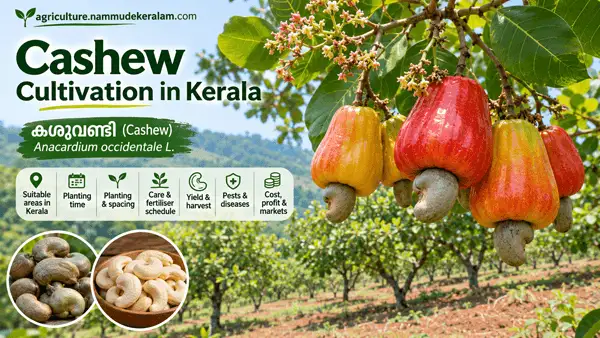
Varieties, Planting, Care, Harvest and Profit Malayalam name: കശുമാവ് (Kashumavu), also called പറങ്കിമാവ് (Parankimavu)Cashew nut: കശുവണ്ടി (Kashuvandi)Cashew apple: കശുമാങ്ങ (Kashumanga)Botanical name: Anacardium…
In this article
50 sections to explore
Varieties, Planting, Care, Harvest and Profit
Malayalam name: കശുമാവ് (Kashumavu), also called പറങ്കിമാവ് (Parankimavu)
Cashew nut: കശുവണ്ടി (Kashuvandi)
Cashew apple: കശുമാങ്ങ (Kashumanga)
Botanical name: Anacardium occidentale L.
Family: Anacardiaceae
Crop type: Perennial tropical tree crop
Main commercial product: Raw cashew nuts (RCN), measured in kilograms per tree per year
Research checked: 4 November 2026
Cashew is a valuable tree crop for Keralam’s coastal areas, laterite uplands and suitable midland regions. It can grow on relatively poor soils, but commercial production requires good drainage, reliable grafts, sunlight, pest control and careful harvesting.
Cashew is not a quick-income crop. Farmers normally establish the orchard during the southwest monsoon and begin commercial harvesting around the third year. Income gradually improves as the trees develop. The orchard may remain productive for several decades.
For farmers with suitable land, the main advantage is that cashew can be grown largely under rainfed conditions. Its main limitation is that income is seasonal, while land maintenance and plant protection expenses continue throughout the year.
1. Where can cashew grow in Keralam?
Suitable districts and growing regions
Cashew is particularly suitable for well-drained laterite uplands and tropical coastal regions.
| Keralam region | General suitability |
|---|---|
| Kasaragod and Kannur | Established cashew-growing regions; laterite uplands and suitable coastal soils |
| Kozhikode and Malappuram | Suitable laterite and midland locations |
| Thrissur and Palakkad | Suitable well-drained midland and warmer upland locations |
| Kollam and Thiruvananthapuram | Suitable coastal and midland sites with good drainage |
| Ernakulam, Alappuzha, Kottayam and Pathanamthitta | Site-dependent; select elevated, well-drained land rather than flood-prone lowlands |
| Wayanad and Idukki | Selective suitability in warmer, lower-elevation areas; cool high-altitude sites are less suitable |
Important: This is a practical regional suitability assessment, not a government-certified district ranking. Even within the same district, one plot may be suitable while another is too wet, shaded or cold.
Climate requirements
| Factor | Published guidance |
|---|---|
| Temperature | About 20–30°C is an ideal range described in NABARD’s cultivation model |
| Rainfall | Approximately 1,000–2,000 mm annually is favourable; cashew also tolerates a much wider rainfall range |
| Altitude | Keralam Agricultural University describes cultivation up to approximately 600–700 metres above sea level |
| Sunlight | Open, unshaded locations with good direct sunlight |
| Dry season | A defined dry period helps flowering and nut development |
| Frost | Unsuitable, especially for young grafts |
| Excessive rain during flowering | Can reduce pollination, flower retention and fruit set |
Keralam’s cashew agency records cultivation across annual rainfall ranges of 600–4,500 mm, while ICAR’s Directorate of Cashew Research describes adaptability from approximately 800–4,000 mm.
These figures describe where cashew may survive and grow. They do not mean that every high-rainfall location will give good commercial yields.
Rain during flowering is a particular concern. Excess moisture and humidity can increase flower drop and fungal infection.
Sources: NABARD cashew cultivation model, ICAR drought advisory, KAU Package of Practices.
Soil requirements
Cashew performs well in red sandy loam, laterite, well-drained sandy soils and suitable light coastal soils.
An ICAR article published in Indian Farming in 2025 gives an ideal soil pH of approximately 5.5–7.5.
Avoid sites with prolonged waterlogging, heavy poorly drained clay, excessive salinity or highly alkaline soil. Soil with a pH above 8 is considered unsuitable for large-scale cultivation in the ICAR reference.
For a new plantation, test the soil before applying lime or fertiliser. A test can identify pH problems, nutrient deficiencies and the need for amendments.
Practical rule: Good drainage is more important than simply having fertile soil. Cashew roots may suffer seriously when water remains stagnant around the trunk.
2. When should cashew be planted?
Best planting season in Keralam
June–July, following the onset of the southwest monsoon, is the main planting period recommended by KAU.
ICAR also describes a wider June–September planting window when the monsoon and soil moisture conditions allow.
Farmers should avoid planting during a dry spell merely because the calendar says June. A healthy graft needs moist soil to establish its root system.
If monsoon onset is delayed, postpone planting until adequate rainfall begins. Where very heavy rain causes temporary waterlogging, wait for suitable field conditions.
Recommended varieties
Keralam has several improved cashew varieties developed and evaluated by agricultural research institutions.
| Variety | Published mean raw-nut yield | Bearing characteristic |
|---|---|---|
| Anakkayam-1 | 12.0 kg/tree/year | Early |
| Madakkathara-1 | 13.8 kg/tree/year | Early |
| Kanaka | 12.8 kg/tree/year | Mid-season |
| Priyanka | 16.9 kg/tree/year | Mid-season |
| Amrutha | 18.35 kg/tree/year | Mid-season |
| Madakkathara-2 | 17.0 kg/tree/year | Late |
Source: Keralam Agricultural University, Package of Practices Recommendations: Crops, 2016, Cashew variety table.
These are published variety-performance figures. They should not be treated as guaranteed yields on ordinary farms. Actual production depends on tree age, rainfall, soils, spacing, orchard care and pest damage.
Variety selection should consider the local flowering season, canopy size, nut quality and availability of genuine planting material.
KAU Nihara, a compact dwarf variety released in 2019, is another option worth discussing with a research nursery for small home gardens. Its suitability for intensive commercial planting should be confirmed locally.
How to select a healthy graft
Use a genuine, labelled softwood graft from a recognised nursery or agricultural research station.
A suitable graft should have a healthy root system, sound graft union, vigorous leaves, no visible pest damage and a known variety name.
KAU states that softwood grafts are generally ready for field planting around five to six months after grafting.
Ask the nursery for the variety name, age, propagation method and receipt. Avoid unlabelled grafts sold only with promises of exceptionally high yield.
Seeds are useful for producing rootstocks, but ordinary seed-grown trees are not recommended for establishing a uniform commercial orchard. Cashew is cross-pollinated, so seedlings may differ considerably from the mother tree.
Sources: KAU Cashew Research Station, Madakkathara, KSACC varieties.
3. How to plant cashew
Propagation
Cashew can be propagated through seeds, air layering, epicotyl grafting and softwood grafting.
Softwood grafting is the preferred commercial method because it preserves the selected variety’s characteristics and generally gives earlier, more uniform bearing than seed propagation.
Farmers establishing a new plantation do not normally need to produce their own grafts. Purchasing genuine nursery grafts is usually more practical.
Spacing and plant population
The following figures are based on square planting layouts and the density recommendations of Keralam’s cashew development agency.
| Planting system | Spacing | Approx. plants per acre | Approx. plants per cent |
|---|---|---|---|
| Normal density | 7 × 7 m | 80–82 | 0.8 |
| Wider normal density | 8 × 8 m | 62–63 | 0.63 |
| High density | 5 × 5 m | 160–162 | 1.6 |
| Ultra-high density | 3 × 3 m | 440–450 | 4.4 |
One acre contains 100 cents, or approximately 4,047 square metres.
These populations are theoretical or rounded planning figures. Actual numbers can be lower because of plot boundaries, roads, buildings, slopes and irregular field shapes.
At 7 × 7 m spacing, one acre accommodates roughly 80 trees.
High-density planting needs greater management, especially regular canopy control. Ultra-high-density planting should be attempted only with suitable varieties, irrigation, pruning knowledge and technical support.
Do not assume that planting more trees means proportionately higher lifetime production. Crowding can reduce yield per tree, and thinning may become necessary.
Pit preparation
KAU recommends planting pits of 50 × 50 × 50 cm for ordinary conditions.
Keralam’s cashew agency also describes 50–60 cm pits for general planting and larger pits of approximately 1 × 1 × 1 metre for plantation establishment, especially where soil depth or hard laterite requires more extensive preparation.
Select the pit size according to soil structure and advice from the local agricultural officer.
KAU recommends adding 5–10 kg of compost or dried cow dung to the pit. KSACC’s detailed cultivation guide describes 10 kg of compost and 200 g of rock phosphate or single superphosphate when preparing larger plantation pits.
Use the soil test and local recommendation before adding phosphorus, particularly where the soil already contains adequate amounts.
Step-by-step planting
- Select land with good sunlight and no standing water.
- Mark the required spacing and keep sufficient access for workers.
- Clear competing weeds and prepare contour planting positions on sloping land.
- Dig the required pits before the monsoon.
- Keep the topsoil separate and refill with the recommended compost mixture.
- Remove the nursery bag carefully without breaking the root ball.
- Place the graft at its original growing depth, keeping the graft union safely above the soil surface.
- Firm the soil gently and support the young tree with a stake.
- Water only as required by soil moisture and rainfall.
- Apply organic mulch around the planting basin without piling it against the trunk.
- Provide temporary protection from strong wind, intense sun or animal damage.
- Check regularly for rootstock shoots emerging below the graft union and remove them.
The nursery graft should never be buried so deeply that the graft joint remains underground.
On sloping land, establish contour-based soil and water conservation measures. Avoid directing concentrated runoff towards the planting pit.
4. How to maintain a cashew plantation
Irrigation
Cashew is commonly grown as a rainfed crop, but additional irrigation can improve flowering, nut development and survival during drought.
ICAR and KSACC report the following supplementary irrigation approaches:
| Situation | Published recommendation |
|---|---|
| Young established grafts during dry conditions | KSACC’s FAQ describes protective watering at approximately fortnightly intervals |
| Mature trees during January–March | 200 litres per tree once every 15 days |
| Drip irrigation during flowering and fruit development | KSACC describes 60–80 litres per tree once every four days |
These recommendations describe particular management conditions. They are not a fixed year-round watering programme.
Young grafts should not automatically receive the large quantities recommended for mature trees. Water should be adjusted for tree age, rainfall, soil texture and moisture.
During monsoon months, provide drainage rather than routine irrigation. During dry periods, check the soil before applying water.
Sources: ICAR weather and drought advisory, KSACC cultivation guide.
Manure and fertiliser
The first step is to obtain a soil test. Cashew grown on poor, acidic laterite soil may need different nutrient management from cashew growing on deeper, more fertile soil.
KAU’s 2016 Package of Practices recommends a mature-tree annual nutrient dose of:
- Nitrogen (N): 750 g/tree
- Phosphate (P₂O₅): 325 g/tree
- Potash (K₂O): 750 g/tree
These are nutrient quantities, not the weights of commercial fertiliser bags.
KAU recommends increasing the dose with tree age.
| Tree age | N | P₂O₅ | K₂O |
|---|---|---|---|
| After first year | 150 g | 65 g | 150 g |
| Second year | 300 g | 130 g | 300 g |
| Third year | 450 g | 195 g | 450 g |
| Fourth year | 600 g | 260 g | 600 g |
| Fifth year onwards | 750 g | 325 g | 750 g |
Calculated from KAU’s one-fifth-per-year progression.
KSACC’s online cultivation guide provides a different schedule expressed in urea, rock phosphate and muriate of potash. The two schedules are not directly equivalent. Therefore, farmers should not combine them or convert them into a single fertiliser prescription without technical advice.
For organic matter, KSACC recommends approximately 10–15 kg of farmyard manure or compost per plant as beneficial.
Apply nutrients within the active root area, away from direct contact with the trunk. The appropriate application zone expands as the tree grows.
Avoid fertiliser application during heavy monsoon rain or severe soil dryness, when nutrient loss or poor absorption may occur. KSACC identifies a break in monsoon rainfall, including around the second week of August, as one possible application opportunity.
The actual timing and dosage should follow the soil-test report and current advice from the Krishi Bhavan or KAU.
Mulching
Mulching helps retain moisture, reduce erosion and suppress weeds.
Suitable materials include dry leaves, straw, suitable grass cuttings and coir-based organic material.
Maintain a clear gap around the trunk to prevent excess moisture accumulation against the bark. On sloping land, use mulching together with contour drains and other soil-conservation measures.
Training and pruning
Young cashew trees should be trained to develop a strong, well-spaced canopy.
KAU recommends maintaining a single main stem up to approximately 0.75–1 metre above the ground, removing unwanted lower shoots gradually.
Remove weak, damaged, dead and crossing branches. Take particular care to remove new shoots growing below the graft union.
Flower panicles should be removed during the first two years under normal-density planting so the tree can establish strong vegetative growth.
May–June is the usual period for pruning mature cashew trees after harvest. Heavy pruning should be avoided unless required for a planned high-density management system or rejuvenation.
Older trees generally need selective removal of dead, damaged and crossing branches rather than severe cutting every year.
Intercropping
Young cashew plantations have open spaces between trees.
These can be used for suitable short-duration crops while the cashew canopy is small.
KAU identifies pineapple, ginger, lemongrass and tapioca as possible intercrops. KSACC also lists several vegetables and legumes, including cowpea and green gram.
Select intercrops according to the season, soil, water availability and market demand.
Do not plant competing crops close to the cashew trunk. Avoid tall crops that heavily shade young cashew plants. Intercropping opportunities gradually reduce as the cashew canopy expands.
Pollination
Cashew produces male and bisexual flowers. Insect pollination, especially by bees, is important for satisfactory nut set.
ICAR research identifies several wild bees and managed honeybees as useful pollinators.
Protecting flowering plants, reducing unnecessary pesticide application and maintaining a suitable habitat for beneficial insects can support pollination.
Never spray insecticides while bees are actively visiting cashew flowers. Where treatment is essential, obtain advice on bee-safe timing and approved products.
Source: ICAR-DCR: Bees and cashew pollination.
5. Keralam cashew farming calendar
This calendar is based on KAU and KSACC’s normal seasonal recommendations. Actual flowering and harvesting dates vary with location, variety and annual weather.
| Month | Main farm activities |
|---|---|
| January | Monitor flowering and fruit set; check tea mosquito bug; provide protective irrigation if needed |
| February | Begin harvesting early varieties where ripe nuts are available; maintain clean collection areas |
| March | Continue harvesting and nut drying; monitor stem and root borer |
| April | Continue harvest of suitable varieties; grade and store dry nuts |
| May | Complete late harvesting; undertake necessary pruning and field preparation before monsoon |
| June | Begin monsoon planting of healthy grafts; improve drainage and mulch young plants |
| July | Continue planting where conditions permit; check graft survival, staking and rootstock shoots |
| August | Weed plantations; maintain drains; apply soil-test-based fertiliser during suitable breaks in rainfall |
| September | Monitor graft establishment, soil erosion and orchard health |
| October | Watch for fresh vegetative growth and early tea mosquito bug damage |
| November | Monitor shoot growth and flowering of early varieties |
| December | Check flowering, pollinators, pest damage and soil moisture; prepare for harvest |
6. When does cashew start yielding?
KAU and KSACC describe commercial bearing from approximately the third year after planting.
Earlier flowering can occur, but keeping the tree free of crop load during the first two years supports better establishment.
The main harvest season in India is generally February–May. Early and late varieties may differ.
Realistic production by tree age
KSACC publishes the following general age-related raw-nut yield guidance.
| Tree age | Published yield guidance |
|---|---|
| Years 1–2 | Generally no commercial harvest when early flowers are removed |
| Years 3–5 | Around 2 kg/tree/year |
| Years 6–10 | Around 4 kg/tree/year |
| Years 11–15 | Around 5–10 kg/tree/year |
| Years 16–20 | More than 10 kg/tree/year possible under suitable conditions |
These are agency guidance figures, not yield guarantees. Newly bearing grafts can produce considerably less, and poorly maintained plantations may remain below these levels.
What does this mean for one acre?
Assume 80 surviving grafted trees planted at approximately 7 × 7 metres.
| Production level | Yield/tree/year | One-acre annual raw-nut production |
|---|---|---|
| Young bearing orchard | 2 kg | 160 kg |
| Developing orchard | 4 kg | 320 kg |
| Established orchard | 5 kg | 400 kg |
| Productive mature orchard | 10 kg | 800 kg |
These one-acre figures are calculated by multiplying the assumed 80 trees by the selected per-tree yield. They are planning illustrations, not measured Keralam farm averages.
Actual production could be lower because of mortality, poor flowering, drought, pests, storm damage or inadequate nutrition.
Production per harvest
Cashew generally has one main annual harvesting season, during which ripe nuts are collected repeatedly.
There is no reliably established universal quantity per individual collection round. Therefore, farmers should plan and record production in kilograms of raw nuts per tree per season and per year, rather than assuming a fixed quantity per picking.
Productive lifespan
ICAR-DCR describes cashew as having a potentially long economic life of 40–50 years. Actual commercial performance depends on whether the tree remains healthy, productive and economically worthwhile to harvest.
Older, overcrowded or low-yielding trees may require rejuvenation, selective replanting or top-working well before that age.
A tree’s biological survival should not be confused with its profitable commercial life.
7. Major pests, diseases and farming risks
Tea mosquito bug
Major warning signs: Blackened feeding marks on tender shoots, drying flower panicles, scorched young leaves, blossom damage and poor fruit set.
Tea mosquito bug commonly becomes important when fresh shoots appear after the monsoon, particularly during October–January.
Management begins with frequent scouting at the appearance of new growth, careful orchard sanitation and removal of badly damaged material.
KSACC describes action when early feeding damage becomes evident, including around the 5–10% damage level. However, farmers should get a current pest-management recommendation before choosing any insecticide.
Avoid indiscriminate spraying, especially during flowering, because beneficial insects and pollinators are essential to cashew production.
Cashew stem and root borer
Major warning signs: Gum and chewed wood fibres around the trunk base, bark injury, small holes, yellowing leaves and gradual canopy decline.
This pest can seriously damage or kill mature trees.
Inspect the lower trunk and root collar regularly, particularly from December to May.
Early detection is crucial. Carefully removing accessible grubs and damaged tissues under technical guidance can help protect affected trees.
Severely damaged or dead trees may need removal to reduce pest carry-over. Avoid unnecessary bark removal or deep cutting into healthy trunk tissue.
Anthracnose
Major warning signs: Dark lesions on tender shoots, black spots on flowers or developing nuts, drying panicles and premature fruit drop.
Wet conditions during flowering can worsen the problem.
Management includes improving canopy ventilation, removing affected plant material, avoiding unnecessary overhead irrigation and using only locally approved fungicide treatments when justified.
KAU and KSACC describe copper-based protective treatments in their published guidance. Use should follow the current registration, product label and agricultural officer’s advice.
Pink disease and gummosis
Pink disease may cause pale fungal growth on branches and progressive twig dieback.
Gummosis can produce cracks in bark and gum exudation. Some symptoms may resemble insect damage, so diagnosis matters before treatment.
Remove affected twigs where appropriate, improve air circulation and obtain technical diagnosis when trunk damage is extensive.
Other risks
| Risk | Possible effect | Practical response |
|---|---|---|
| Waterlogging | Root damage, decline and plant death | Improve drainage and avoid flood-prone plots |
| Extended drought | Flower drying, fruit drop and low nut weight | Mulching, water conservation and protective irrigation |
| Heavy rain at flowering | Flower drop, disease and reduced nut set | Maintain ventilation, drainage and pest monitoring |
| Strong wind | Broken branches or uprooted young grafts | Staking, suitable shelter and canopy care |
| Wild animals | Damage to young bark and grafts | Protect trunks with suitable guards |
| Poor-quality grafts | Variable yield and delayed production | Buy labelled plants from trusted nurseries |
| Excessive pesticide spraying | Pollinator loss and unnecessary expense | Use monitoring-based integrated pest management |
Older publications may contain pesticides or application methods that are no longer appropriate under current registration rules. Farmers should use only products currently approved for the intended crop and pest, following the label and local agricultural advice.
8. Harvesting and post-harvest management
How to recognise mature cashew
The cashew nut develops outside the fleshy cashew apple.
Mature cashew apples develop their characteristic colour and eventually fall naturally when ripe.
The main commercial product is the raw nut enclosed in its shell. The edible kernel is obtained only after suitable processing.
Harvesting procedure
Collect freshly fallen mature cashew apples and nuts regularly.
Separate the raw nut from the apple carefully. Avoid damaging the nut, and keep harvested material away from soil contamination, rain and standing water.
Do not collect rotten or mouldy material for storage with healthy nuts.
Drying and storage
Proper drying is essential for safe storage and better sale quality.
ICAR’s 2025 publication describes dried raw cashew nuts with approximately 8–9% moisture as suitable for longer-term storage, potentially up to one year under appropriate conditions.
Dry nuts on a clean, suitable drying surface, protecting them from unexpected rain. Drying time varies with weather and starting moisture; a fixed number of days cannot guarantee the target moisture level.
Store dry nuts in clean, dry, ventilated bags above floor level, protected from rodents and moisture.
Wet raw nuts should not be sealed in storage bags.
Processing and value addition
Farmers can potentially earn additional income from processed cashew kernels and cashew-apple products such as juice, syrup, jam, vinegar and pickles.
However, cashew processing is not simply cracking a raw nut.
The shell contains cashew nut shell liquid, a caustic substance that can cause skin injury. Proper shelling, heat treatment, protective equipment and processing expertise are essential.
Farmers intending to produce packaged food should also check applicable FSSAI registration or licensing, hygiene, packaging and labelling requirements.
Small farmers may find it more practical to sell properly dried raw nuts to an established processor rather than investing immediately in processing equipment.
Source: ICAR Indian Farming, August 2025.
9. How much money can cashew cultivation earn?
Cashew profitability depends on land conditions, orchard age, labour costs, production and the actual selling price of raw nuts.
Farmers should distinguish three different financial figures:
- Establishment cost: Initial plantation preparation and planting.
- Annual operating cost: Labour, manure, pest management, harvesting and maintenance.
- Net farm income: Actual sales revenue minus applicable costs.
Verified raw-nut price references
Keralam’s cashew development agency publishes an indicative raw-nut price range of ₹130–₹140 per kg in its online FAQ. The FAQ does not provide a transaction date, so this should not be presented as a confirmed November 2026 buying price.
A third-party reproduction of mandi data reports a ₹122/kg modal wholesale price for local raw cashew nuts at Kasaragod Market on 21 October 2026, equivalent to ₹12,200 per quintal. The reported market range was ₹120–₹125/kg for that entry.
The dated mandi figure is useful for price discovery, but it has not been independently verified against the original government transaction record.
Farm-gate offers may differ from mandi prices because of moisture, grading, quantity, transport and buyer requirements.
Sources: KSACC price FAQ, Kasaragod mandi price history.
Establishment costs: published reference
KSACC publishes a historical organic cashew cultivation model for one hectare with approximately 200 trees, using a labour rate of ₹800 per worker-day.
The underlying first-year budget is dated 2018–19. Therefore, it must not be presented as a verified 2026 contractor quotation.
Its published itemised expenses, converted proportionately to approximately one acre, are:
| First-year expense | Approximate cost per acre |
|---|---|
| Land clearing | ₹8,100 |
| Cleaning and levelling | ₹8,100 |
| Terracing | ₹13,000 |
| Pit making | ₹6,500 |
| Grafts and transportation | ₹4,000 |
| Planting and staking labour | ₹3,200 |
| Manure application labour | ₹1,000 |
| Plant protection labour | ₹650 |
| Irrigation labour | ₹6,500 |
| Intercultural-operation labour | ₹6,500 |
| Organic manure purchase | ₹3,200 |
| Plant protection inputs | ₹1,600 |
| Miscellaneous | ₹4,200 |
| Itemised total, rounded | ₹66,550 |
Important source limitation: KSACC’s published first-year table lists a total of ₹1,50,000 per hectare, but adding its individual expense rows produces ₹1,64,400 per hectare. The approximately ₹66,550 figure above is based on the itemised rows, not the inconsistent printed total.
This proportional one-acre conversion is an illustration. Actual small-farm costs may be higher per unit because of minimum contractor charges. Terracing may be unnecessary on level land, while fencing, irrigation infrastructure or difficult pit digging can considerably increase costs.
A free-graft scheme can reduce the purchase cost, but eligibility must be confirmed.
Annual maintenance costs
KSACC’s historical model describes annual expenses of approximately ₹60,000–₹62,000 per hectare after establishment.
At ₹62,000 per hectare, proportional annual expenses are approximately ₹25,100 per acre.
The model includes labour for manuring, pest management, intercultural work and harvesting, along with manure, pest-management materials and miscellaneous expenses.
This is a historical model-based budget, not a verified current quotation. It also does not establish the full economic cost of owning land, financing the farm or using family labour.
Example profit-and-loss calculations
Assumptions for the following illustrations:
- One acre with 80 productive cashew trees.
- Raw-nut sale price: ₹122/kg, based on the dated Kasaragod wholesale observation.
- Annual operating expense: ₹25,100, derived from KSACC’s historical model.
- No added income from intercrops or cashew apples.
- Excludes land purchase or rent, interest, depreciation, taxes and exceptional losses.
- All produce is assumed saleable at the stated price.
| Scenario | Raw-nut production | Gross sales | Annual operating result |
|---|---|---|---|
| Young orchard, 2 kg/tree | 160 kg | ₹19,520 | −₹5,580 |
| Developing orchard, 4 kg/tree | 320 kg | ₹39,040 | ₹13,940 |
| Established orchard, 5 kg/tree | 400 kg | ₹48,800 | ₹23,700 |
| Productive orchard, 10 kg/tree | 800 kg | ₹97,600 | ₹72,500 |
These figures are calculated scenarios, not field-trial profit results.
They show why cashew cultivation requires patience. A young orchard can operate at a loss, while a healthy productive orchard may generate better annual income.
The table does not deduct the original plantation investment. Therefore, a positive operating result is not the same as full investment recovery.
The break-even raw-nut quantity at ₹122/kg and ₹25,100 annual operating expense is approximately 206 kg per acre, before recovering establishment costs and the other excluded expenses.
Farmers should obtain local wage quotations, input prices and buyer offers before preparing a bankable investment proposal.
Source for historical cost model: KSACC Economics of Cashew.
10. Where can farmers sell cashew?
Possible marketing channels include local raw-nut traders, established cashew processors, farmer collectives, cooperatives and buyers linked to Keralam’s cashew industry.
Keralam has established processing activity associated with the Keralam State Cashew Development Corporation (KSCDC) and CAPEX.
KSACC states that it helps facilitate links to these organisations, but it does not operate its own direct marketing unit.
Before finalising a sale, obtain a buyer’s current offer and clarify the required moisture, grade, collection arrangements, weighing procedure and payment terms.
Farmers should compare the net realised price after transport and deductions, rather than choosing buyers by headline price alone.
11. Government support and assistance
Keralam State Agency for the Expansion of Cashew Cultivation (KSACC)
KSACC publishes support for normal-density and high-density cashew planting.
The agency’s scheme page describes free supply of grafts and financial assistance of ₹100 per plant, including the cost of grafts, distributed in three annual instalments in the ratio 60:20:20, subject to funding, verification and graft-survival conditions.
For normal-density planting, the scheme page specifies a minimum holding of one acre. The high-density scheme specifies at least one acre of plain land.
KSACC separately describes ultra-high-density planting and the Muttathoru Kasumavu household planting initiative.
The agency’s general FAQ mentions planting participation from 10 cents, but this does not override the one-acre condition published for particular subsidy schemes.
For an illustration, 80 eligible grafts at the published ₹100-per-plant assistance rate would represent up to ₹8,000 in total scheme support, including the planting-material component, subject to the actual approval and rules. This should not be understood as ₹8,000 of cash assistance in addition to free grafts.
The Keralam State Planning Board’s 2025–26 Annual Plan confirms the ₹100-per-plant framework for normal- and high-density planting. The KSACC website also shows preparation relating to 2026–27 graft distribution, but that alone does not verify that every funding component and eligibility condition remains unchanged for 2026–27.
Farmers should confirm the current application window and entitlement directly before incurring expenses.
Official sources
- KSACC planting schemes
- KSACC farmer FAQs and application procedure
- Keralam State Planning Board Annual Plan 2025–26
State Horticulture Mission
Cashew is included among crops supported under the Mission for Integrated Development of Horticulture (MIDH).
Assistance may relate to eligible horticulture development and processing activities, depending on approved components and current guidelines.
Farmers should not assume automatic eligibility or stack multiple subsidies for the same expense without approval.
Official source: Keralam State Horticulture Mission.
How to enquire
Begin with the nearest Krishi Bhavan or an authorised KSACC field official.
The KSACC FAQ lists identity proof, ration card and bank passbook copy among the documents associated with graft applications.
Confirm the latest documentation requirements, land eligibility, plantation inspection requirements and whether assistance needs prior sanction.
12. Five frequently asked questions
1. Can I grow cashew on 10 cents of land?
Yes, if the plot has adequate sunlight, drainage and room for a mature tree. A compact variety may be preferable for a small home garden. Ten cents is not necessarily eligible for commercial plantation subsidies that specify a one-acre minimum.
2. Does cashew need daily watering?
No. Cashew is commonly a rainfed crop. Newly planted grafts need adequate moisture for establishment, and supplementary irrigation during dry flowering periods may improve yield. Overwatering and waterlogging are harmful.
3. Can I plant a cashew nut instead of buying a graft?
A raw cashew seed can produce a tree, but its performance may differ from the parent. Commercial orchards should normally use authenticated vegetatively propagated grafts for greater uniformity.
4. Why is my cashew tree flowering but producing very few nuts?
Possible causes include tea mosquito bug damage, poor pollination, drought, rain during flowering, nutrient problems and unsuitable canopy conditions. Inspect the flowers and tender shoots before deciding on treatment.
5. Is one acre of cashew cultivation profitable?
It can be profitable under favourable conditions, but profits are not assured. Yield is normally low during the early years, and local labour costs can be substantial. Prepare a realistic budget using actual buyer offers and input quotations.
13. Farmer checklist
Before planting:
- Confirm that the land receives good sunlight.
- Check soil drainage and obtain a soil test.
- Confirm that the location is suitable for cashew.
- Select a recommended variety and genuine nursery grafts.
- Decide on normal or high-density spacing.
- Prepare pits and drainage before planting.
- Obtain a local estimate of planting and labour costs.
- Check KSACC graft availability and scheme eligibility.
After planting:
- Protect grafts from wind and animal damage.
- Keep the graft union above ground and remove rootstock shoots.
- Maintain moisture without waterlogging.
- Apply mulch without touching the trunk.
- Follow the approved soil-test-based nutrient plan.
- Monitor pests during new growth and flowering.
- Protect bees and other pollinators.
- Remove early flowers as recommended.
- Record each tree’s annual raw-nut production.
- Dry, grade and store harvested nuts properly.
- Compare buyer offers before sale.
- Update farm costs and net income every season.
14. Final advice for Keralam farmers
Cashew is worth considering where land is well drained, receives good sunlight and is suitable for a long-term tree crop.
The key to success is not simply planting more trees. Good grafts, appropriate spacing, adequate root development, sensible nutrient management, protection from pests and careful post-harvest handling are more important.
Farmers should start with an honest assessment of land, available labour and expected market access. A small, well-maintained plantation can be a better investment than a larger orchard that receives little attention.
Use published research as a technical starting point, but use current local quotations and actual farm production records for financial decisions.
Sources and research references
All sources checked on 4 November 2026. Publication dates are identified where available. Some official technical pages are undated and should be rechecked before future updates.
- Keralam Agricultural University — Package of Practices Recommendations: Crops, 2016 (15th edition). Main source for Keralam planting season, varieties, pruning, spacing, nutrient recommendations, pests and cashew-apple utilisation.
- KAU — Cashew Research Station, Madakkathara. Research varieties and nursery expertise.
- ICAR — Indian Farming, August 2025. Soil pH, planting, canopy management, harvest and storage recommendations.
- ICAR-Directorate of Cashew Research — Weather Advisory. Drought management and supplementary irrigation.
- ICAR-Directorate of Cashew Research — Cashew. Crop characteristics and long-term economic potential.
- ICAR-Directorate of Cashew Research — Beneficial Bees. Pollination and the importance of avoiding sprays during bee activity.
- Keralam State Agency for the Expansion of Cashew Cultivation — Cultivation Guide. Practical planting, nutrient management, water management, pests and yield by tree age.
- KSACC — Economics of Cashew. Historical itemised plantation costs, yield scenarios and projected returns. Contains an internal first-year cost-total discrepancy, noted in this article.
- KSACC — Planting Schemes and FAQs. Graft distribution, published assistance and eligibility conditions.
- Keralam State Planning Board — Annual Plan 2025–26. Government-approved planning framework for cashew cultivation assistance.
- Keralam State Horticulture Mission — Scheme Details. MIDH horticulture coverage and eligibility context.
- NABARD — Model Profile for One-Hectare Cashew Cultivation. General climate, soil and commercial planting recommendations. Contains older technical and economic context; verify current practices before field use.
- Kasaragod Market Price History — Third-party mandi-data reproduction. Dated local raw-cashew wholesale observation, 21 October 2026. Not independently confirmed against the original government feed.
Agricultural practices vary by crop, season and location. Use this guide as a reference, and check available sources and local conditions before making decisions.
Knowledge grows when we share it.
Nammude Keralam
Nammude Keralam
Share this article with another grower or farming enthusiast.