At a glance
Black Pepper Plantation in Keralam Malayalam name: കുരുമുളക് (Kurumulaku)Botanical name: Piper nigrum L.Family: PiperaceaeCrop type: Perennial climbing spice vineMain product: Dried black…
In this article
50 sections to explore
Black Pepper Plantation in Keralam
Malayalam name: കുരുമുളക് (Kurumulaku)
Botanical name: Piper nigrum L.
Family: Piperaceae
Crop type: Perennial climbing spice vine
Main product: Dried black peppercorns
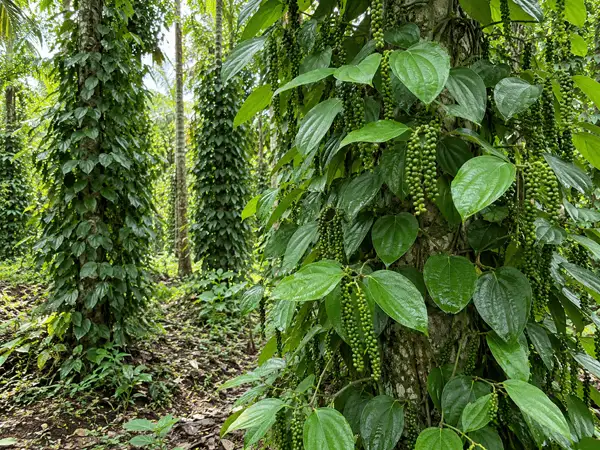
Black pepper is one of Keralam’s important traditional spice crops. It can be grown in a separate plantation or trained on suitable trees in coconut, arecanut and mixed-crop gardens.
It is a long-term crop. Farmers need a healthy climbing support, good drainage, suitable planting material and regular care. The vines can produce for many years, but waterlogging, diseases, poor flowering and ageing vines can reduce income significantly.
This guide explains how to establish and manage a black pepper plantation without assuming that every plant will achieve research-station yields.
1. Where can black pepper grow in Keralam?
Black pepper grows best in humid, warm locations with organic-rich soil and good drainage.
Suitable districts and regions
| Region | Suitability and important considerations |
|---|---|
| Idukki | Major production district; suitable highland and midland sites with good drainage |
| Wayanad | Important growing district; altitude, soil and summer moisture vary considerably |
| Kannur and Kasaragod | Suitable humid midlands, foothills and mixed-crop gardens |
| Kozhikode and Malappuram | Suitable laterite midlands, foothills and established tree-based farms |
| Kottayam and Pathanamthitta | Suitable well-drained, humid plantation and mixed-crop areas |
| Ernakulam and Thrissur | Suitable sites exist, particularly inland and well-drained areas |
| Kollam and Thiruvananthapuram | Suitable humid upland and midland locations; variety selection matters |
| Palakkad | Suitable wetter, sheltered locations; hot and dry sites need particular care |
| Alappuzha and other low-lying coastal areas | Possible in suitable gardens, but waterlogging, salinity and poor drainage may make commercial planting unsuitable |
These are regional suitability assessments, not a claim that every locality within a district is suitable.
According to Keralam’s Agricultural Statistics 2023–24, Idukki produced 18,217.39 tonnes, or approximately 59.15% of Keralam’s black pepper production. Wayanad produced 3,316.13 tonnes and ranked second.
Climate and soil requirements
| Factor | Research-supported guidance |
|---|---|
| Temperature | ICAR-IISR favourable range: 23–32°C, approximately 28°C ideal |
| Rainfall | ICAR-IISR: 1,250–2,000 mm/year, well distributed |
| Humidity | ICAR-IISR ideal relative humidity: 75–80% |
| Altitude | ICAR describes cultivation up to 1,500 m; KAU gives a more conservative range up to 1,200 m, with lower elevations generally preferable |
| Soil pH | 5.5–6.5 according to ICAR-IISR |
| Soil | Porous, organic-rich, well-drained laterite or suitable loam |
| Sunlight | Partial or filtered sunlight; avoid scorching sun on young vines and excessive shade |
| Drainage | Essential; even short periods of water stagnation can damage the roots |
The figures describe favourable growing conditions, not strict limits for every surviving vine.
Rainfall distribution is particularly important. KAU explains that around 70 mm of rain over 20 days can trigger flushing and flowering, but a dry spell during subsequent fruit development may cause considerable yield loss.
Before planting: Ask the local Krishi Bhavan to assess soil pH, drainage, irrigation availability and the suitability of the chosen support trees.
2. When to plant and which variety to choose
Best planting season
June–July, with the southwest monsoon, is KAU’s recommended period for field-planting rooted black pepper cuttings.
Planting should begin after sufficient rain has moistened the soil, but only where drainage is working.
Support-tree cuttings such as murukku can be established during April–May with pre-monsoon showers. Slower-growing supports, including silver oak, should be established approximately 2–3 years before the pepper vines.
Suitable varieties
| Variety | Research-supported characteristics |
|---|---|
| Karimunda | Widely cultivated traditional Keralam variety |
| Panniyur-1 | Suitable for comparatively open conditions; avoid heavy shade |
| Panniyur-2 | Tolerates shade relatively well |
| Panniyur-5 | Suited to shaded conditions |
| Panniyur-6 and 7 | Suitable across black pepper-growing areas |
| Sreekara | ICAR-IISR selection with broad adaptability |
| Subhakara | ICAR-IISR selection suitable for Keralam pepper tracts |
| Pournami | Reported tolerance to root-knot nematode infection |
| IISR Thevam | Reported tolerance to Phytophthora foot rot |
| IISR Chandra | Early-maturing hybrid released in 2023; suited to Keralam pepper-growing regions |
Disease tolerance does not mean complete immunity.
For heavy shade, high altitude, drought-prone land or a known foot-rot problem, obtain a site-specific variety recommendation rather than selecting solely by published maximum yield.
How to select planting material
Black pepper is usually planted using rooted vegetative cuttings, not seeds or ordinary botanical seedlings.
Choose plants that have:
- A known variety name and a traceable, healthy mother plant.
- Vigorous green growth and a healthy root system.
- No blackened stem, root decay, unusual yellowing or visible pest infestation.
- Well-developed roots without excessive root binding.
- A nursery source that uses disease prevention and clean potting media.
KAU recommends selecting mother vines aged 5–12 years, with a record of regular production and healthy growth.
Use climbing or runner-shoot cuttings for normal pepper cultivation. Cuttings taken from fruiting lateral branches produce bush pepper, a different growing form suited to pots or specific cultivation systems.
Farmers can enquire at KAU’s Pepper Research Station, Panniyur, ICAR-IISR, government nurseries and Krishi Bhavans.
3. How to plant black pepper
Propagation and nursery preparation
For farmers producing their own planting material, the conventional method uses runner shoots collected from healthy, productive vines.
- Select a healthy, true-to-type mother vine.
- Keep its runner shoots raised above the ground to prevent unwanted rooting and contact with contaminated soil.
- Collect suitable runner shoots during February–March.
- Prepare cuttings with 2–3 nodes each.
- Use the KAU nursery mixture of 2 parts fertile topsoil, 1 part river sand and 1 part well-rotted cattle manure.
- Plant at least one node in the nursery medium, keeping the cuttings shaded.
- Water as needed to keep the mixture moist, never waterlogged.
- Transplant only healthy, adequately rooted and hardened cuttings.
KAU also describes serpentine layering, in which successive nodes are rooted in individual bags. This is useful for producing larger numbers of uniform cuttings.
For a small plantation, purchasing healthy rooted cuttings from a dependable nursery is generally simpler than establishing a specialist propagation unit.
Suitable support trees
Black pepper climbs by attaching itself to a living or suitable permanent support, commonly called a standard.
KAU lists supports including:
- Murukku (Erythrina species)
- Garuga (Garuga pinnata)
- Silver oak (Grevillea robusta)
- Suitable established coconut or arecanut trees
The choice depends on the site, shade, tree growth, root competition and the ability to harvest safely.
Spacing and plant numbers
| Planting pattern | Area per support | Theoretical supports per acre | Theoretical supports per cent |
|---|---|---|---|
| 3 m × 3 m on level land | 9 m² | About 450 | About 4.5 |
| 2 m × 4 m across slopes | 8 m² | About 506 | About 5.1 |
These are calculated support positions, not guaranteed productive vine counts. Roads, boundaries, drains, existing trees and unusable land reduce the actual number.
KAU recommends 2–3 rooted cuttings per planting pit/support. Therefore, a theoretical one-acre plantation with 450 support positions may initially require about 900–1,350 rooted cuttings. Establishment losses and later training must be considered separately.
For pepper grown on existing coconut or arecanut trees, calculate the number of usable trees individually instead of applying the full-plantation density.
Step-by-step field planting
- Choose the site. Avoid waterlogged locations and exposed slopes where summer sunlight is severe.
- Prepare drainage. On sloping land, use suitable contour measures to limit soil erosion.
- Establish the standards. Use healthy, well-positioned support trees.
- Prepare the planting pit. KAU recommends a 50 × 50 × 50 cm pit on the northern side of the standard.
- Fill the pit. Mix the topsoil with approximately 5 kg of well-rotted cattle manure or compost. KAU also recommends 50 g of an appropriate Trichoderma formulation at planting; verify product specifications and suitability locally.
- Plant the cuttings. Set 2–3 healthy rooted cuttings approximately 30 cm from the support.
- Firm the soil. Form a slight outward slope around the planting area so water does not collect around the stem.
- Train the shoots. Gently tie new climbing shoots to the support.
- Provide temporary shade. Protect young vines during exposed or dry periods.
- Inspect after heavy rain. Correct stagnant water, loose supports and root exposure immediately.
When using existing coconut or arecanut palms, KAU recommends planting approximately 1–1.5 m from the trunk, initially training the vine on a temporary support.
4. How to maintain the plantation
Irrigation
Pepper is commonly grown as a rainfed crop, but supplementary irrigation can improve performance under suitable conditions.
KAU reports that irrigating Panniyur-1 at approximately 100 litres per vine every 8–10 days from November/December to March increased yield under the tested Panniyur conditions.
ICAR-IISR separately recommends, for summer irrigation from 15 March to 15 May, approximately:
| Vine age | Water per irrigation | Frequency in the cited ICAR recommendation |
|---|---|---|
| 5–10 years | 30 litres | Every 15 days |
| 11–15 years | 40 litres | Every 15 days |
| More than 15 years | 50 litres | Every 15 days |
These are different research recommendations for different conditions. Do not combine the quantities or treat either as a universal irrigation schedule.
KAU also provides specific schedules for Wayanad’s agro-ecological units:
- Northern high hills: 25 litres/vine at 5–7-day intervals.
- Central plateau: 35 litres/vine at 7–10-day intervals.
- Eastern plateau: 20 litres/vine at 4–7-day intervals.
These Wayanad recommendations depend on the specified soil and agro-ecological conditions.
For young vines, irrigation should be adjusted to root development, weather and soil moisture. Stop unnecessary irrigation when rainfall is adequate and never allow stagnant water around the roots.
Manuring and fertilisers
KAU recommends 10 kg of cattle manure, compost or green organic material per established vine annually, usually around the onset of the southwest monsoon.
The published general annual chemical nutrient recommendation for pepper vines aged three years and above is:
| Nutrient | General recommendation, per vine/year |
|---|---|
| Nitrogen (N) | 50 g |
| Phosphate (P₂O₅) | 50 g |
| Potash (K₂O) | 150 g |
These are nutrient quantities, not grams of an NPK fertiliser mixture.
KAU also gives different recommendations for certain regions:
- Panniyur and similar areas: 50:50:200 g N₂O₅₂O/vine/year
- Kozhikode and similar areas: 140:55:275 g N₂O₅₂O/vine/year
This variation makes soil testing important. The farmer should not simply apply the largest published dose.
Under KAU’s recommendations, one-year-old plants receive approximately one-third of the relevant full dose and two-year-old plants one-half. The full recommended dose begins from the third year.
Apply in two splits:
- May–June: After sufficient soaking rain.
- August–September: During the later monsoon period.
Apply around the root zone, cover lightly and avoid direct contact between fertilisers and roots. Have the Krishi Bhavan calculate actual product quantities from the soil-test report and the nutrient percentages printed on fertiliser bags.
KAU describes applying 500 g lime per vine in alternate years during April–May, while ICAR emphasises its use in highly acidic soils. Treat liming as a soil-test-based decision, not an automatic addition to every farm.
Mulching, training and pruning
Mulch with suitable dry leaves, arecanut husk or similar clean organic material to reduce moisture loss and soil splash. Keep the material away from direct contact with the stem collar.
Train young shoots onto the support and prevent runner shoots from spreading across wet soil.
KAU recommends:
- Pruning support trees during March–April.
- Additional shade regulation in July–August, where needed.
- Limiting the effective height of standards to approximately 6 m.
- Removing unwanted terminal and hanging shoots when necessary.
Do not prune aggressively during severe heat or when a vine is already stressed.
Intercropping
KAU identifies ginger, turmeric, colocasia and elephant foot yam as possible intercrops in pepper gardens.
Young banana plants can provide temporary shade. However, KAU warns that banana in yielding pepper gardens can reduce pepper production and does not recommend continuing this combination beyond the early establishment years.
With coconut or arecanut, manage fertilisers, irrigation and root competition for each crop separately.
Pollination
Black pepper is predominantly self-pollinated. Rainfall and water movement can assist pollination, and wind may contribute to pollen movement.
Farmers do not normally need to plant separate male and female vines or hand-pollinate a commercial crop.
Maintaining a healthy canopy, proper moisture and suitable weather conditions during flowering is more important than attempting artificial pollination.
5. Month-by-month black pepper farming calendar
This calendar follows Keralam’s usual monsoon and crop cycle. It is a planning guide, not a fixed schedule for every altitude or district.
| Month | Main activities |
|---|---|
| January | Harvest mature spikes where the crop is ready; dry, grade and store produce; monitor dry-season moisture |
| February | Continue harvest in later regions; identify healthy mother vines and prepare runner cuttings |
| March | Continue hill-region harvest where applicable; manage summer irrigation; prune support trees |
| April | Test soil, arrange nursery plants, improve drainage, establish suitable supports and review soil acidity |
| May | Complete pit preparation; apply recommended pre-monsoon amendments; prepare for disease prevention |
| June | Main planting period; train young vines; monitor flowering, drainage and foot-rot symptoms |
| July | Complete suitable monsoon planting; regulate excess shade; check tender growth and pest activity |
| August | Apply the recommended second fertiliser split where appropriate; inspect roots and leaves after heavy rain |
| September | Continue disease and pest surveillance; inspect spikes and berries; maintain drainage |
| October | Check pollu beetle damage and yellowing or declining vines; plan labour and drying facilities |
| November | Begin harvesting in suitable plains; start dry-season moisture management |
| December | Continue harvesting in suitable areas; clean, dry and store pepper; assess the year’s performance |
The harvest period changes with elevation, rainfall, variety and the timing of flowering.
6. When can farmers harvest, and how much?
Time to first harvest
Black pepper generally starts yielding in the third or fourth year after planting. The first crop may be small and should not be treated as evidence of mature yield.
Research on pepper trained on arecanut palms describes bearing from the third year and potential production being reached by approximately the tenth year under the studied conditions.
KAU notes that vines of many varieties may begin showing declining yields after around 20 years of regular bearing. A planned underplanting programme can then replace older vines gradually.
Flowering and harvest season
According to KAU:
- Flowering commonly occurs in May–June.
- Fruit development takes approximately 6–8 months after flowering.
- Harvest commonly occurs from November–January in the plains.
- In hill regions, harvest may extend from January–March.
Harvest the whole spike when one or two berries have changed to a bright orange colour. Harvest only spikes that have reached the appropriate maturity for the intended product.
Yield: research trials versus real farms
Official Keralam statewide figure
The Department of Economics and Statistics reported for 2023–24:
- Area: 72,669.27 hectares
- Production: 30,798.21 tonnes
- Average productivity: 424 kg of dry pepper/hectare/year
- Equivalent: approximately 172 kg of dry pepper/acre/year
This is a statewide average, not the expected yield of every well-managed mature plantation. It includes areas with different plant ages, survival, planting densities and management standards.
Selected ICAR-IISR variety figures
| Variety | Published dry yield | Equivalent per acre, calculated |
|---|---|---|
| Subhakara | 2,352 kg/ha | About 952 kg/acre |
| Sreekara | 2,677 kg/ha | About 1,083 kg/acre |
| IISR Chandra | 2,905 kg/ha | About 1,176 kg/acre |
These are published varietal performance figures under research/evaluation conditions. They are not guaranteed commercial yields.
For individual vines, ICAR-IISR reports the following green-pepper figures:
- Subhakara: 4.2 kg green pepper/vine, with 35.5% dry recovery.
- Sreekara: 4.8 kg green pepper/vine, with 35% dry recovery.
- IISR Chandra: 7.5 kg green pepper/vine, with 33.5% dry recovery.
The above figures are varietal performance data, not a reliable average for every established vine in Keralam.
A practical production-planning illustration
Suppose a farmer has one acre with approximately 450 support positions. The table below converts possible total annual dry harvests into average output per occupied support position.
| Annual dry pepper harvest | Calculated average per 450 support positions | Interpretation |
|---|---|---|
| 100 kg/acre | 0.22 kg/support | Low-output planning case |
| 170 kg/acre | 0.38 kg/support | Near the published statewide average per acre |
| 300 kg/acre | 0.67 kg/support | Better-output planning case, not guaranteed |
These three rows are planning scenarios, not measured research yields. An occupied support may carry more than one rooted cutting. Therefore, yield per support should not be confused with yield per individual vine.
For years 1–2, it is prudent to budget for no dependable commercial income. Yield in years 3–4 is highly variable, and no sufficiently reliable Keralam-wide age-specific kilogram figure was found for publication.
Yield per harvest versus annual yield
Black pepper generally produces one main seasonal crop each year, although mature spikes may be collected in multiple rounds.
The kilograms collected in each picking round depend on ripening and labour schedules. A verified Keralam-wide figure for kilograms per picking round was not available.
Keep records of each picking and calculate the annual total dry weight after processing.
7. Common pests, diseases and farming problems
Disease prevention matters because a severely damaged pepper vine can take years to replace.
| Problem | Warning signs | First response |
|---|---|---|
| Foot rot / quick wilt (Phytophthora capsici) | Black leaf lesions, rotting near the collar, wilting, falling leaves and sudden collapse | Improve drainage, prevent root damage, isolate affected material and seek immediate diagnosis |
| Pollu beetle (Longitarsus nigripennis) | Hollow, blackened or damaged berries; damage to tender spikes | Inspect spikes regularly, regulate dense shade and confirm pest presence |
| Leaf gall thrips | Curled leaf margins, distorted or crinkled leaves | Inspect young vines and nursery plants; remove heavily damaged material where advised |
| Scale insects | Small encrustations on stems and leaves, yellowing and reduced vigour | Inspect early, remove severely infested branches, and use recommended targeted controls |
| Top shoot borer | Blackening and drying of young growing tips | Inspect tender flushes and remove affected shoots where appropriate |
| Nematodes and slow decline | Gradual yellowing, weak growth, poor roots, sometimes root galls | Obtain root and soil diagnosis; use healthy planting material and approved biological measures |
| Viral diseases | Unusual mottling, distorted leaves and stunted growth | Seek confirmation; remove infected planting sources and manage the vectors as advised |
Safe integrated pest and disease management
Start with prevention:
- Use disease-free rooted cuttings from a dependable source.
- Maintain surface and subsurface drainage.
- Avoid injuring feeder roots.
- Keep runner shoots off wet soil.
- Avoid excessive shade and dense, humid growth.
- Use clean nursery mixtures and suitable registered biological agents.
- Inspect plants regularly, particularly during the monsoon.
- Remove and safely dispose of severely infected material following local plant-protection advice.
- Keep a record of symptoms, treatments and weather.
KAU and ICAR describe biological measures involving appropriate Trichoderma, Pseudomonas and other beneficial organisms. Selection, application rates and compatibility depend on the formulation and the diagnosed problem.
Their publications also contain older chemical-control recommendations. Do not automatically follow a historical pesticide prescription. Use a product only after confirming its present legal registration for black pepper and the particular pest or disease, authorised label dose, protective equipment, pre-harvest interval and applicable residue requirements.
Consult the local Krishi Bhavan or qualified crop-protection specialist before pesticide use. Never mix pesticides without authorised instructions or spray in unsafe weather.
Weather risks
Heavy or continuous rainfall: Root rot, water stagnation, soil erosion and poor drying conditions.
Dry spells during flowering and fruit development: Reduced fruit set and lower yield.
High summer temperature: Leaf scorch, moisture stress and poor establishment of young vines.
Strong winds: Damage to support trees and climbing vines.
Poorly timed shade pruning: Excess exposure to sun or excessive humidity around the crop.
Common mistakes to avoid
- Planting without ensuring drainage.
- Buying unlabelled or visibly unhealthy cuttings.
- Using the wrong variety for local shade conditions.
- Placing fertiliser directly against the stem or roots.
- Treating the highest research yield as a guaranteed commercial return.
- Assuming two or three cuttings on a support are equivalent to two or three fully productive mature vines.
- Harvesting immature spikes too early.
- Drying pepper on dirty surfaces or storing damp berries.
- Allowing old, declining vines to remain without a replacement plan.
8. Harvesting, processing, storage and selling
Preparing black pepper for sale
- Harvest adequately mature spikes.
- Separate the berries from the stalks.
- Remove plant debris, visibly damaged berries and foreign material.
- Dry the berries on a clean, food-safe drying surface or suitable hygienic dryer.
- Turn the berries regularly to achieve even drying.
- Protect the material from rain, animals, dust and soil contamination.
- Check the moisture content before packing.
- Grade and pack the dried pepper in clean, dry, food-safe packaging.
KAU describes sun drying over approximately 7–10 days in its harvest guidance. Its separate processing guidance describes 3–5 days under suitable conditions. Actual drying time depends on weather, berry condition and the method used.
Measure moisture rather than trusting a fixed number of drying days.
The Spices Board recommends packing black pepper for storage at about 10–11% moisture. The stated FSSAI maximum for dried black pepper berries is 13%, but that legal maximum should not be mistaken for the preferred storage target.
Keep bags off the floor on suitable pallets and away from damp walls. Maintain separation between cleaned/graded produce and ungraded produce.
Black pepper and other products
- Black pepper: Made from mature, normally unripe berries that are dried.
- White pepper: Produced by removal of the outer fruit covering through an appropriate processing method.
- Dehydrated green pepper: A specialist product requiring suitable processing and quality control.
- Ground pepper: Requires additional hygiene, packaging, labelling and quality safeguards.
Value addition can increase potential selling prices, but it also adds equipment, food-safety compliance, packaging, marketing and working-capital costs.
Do not assume a premium without confirmed buyers.
Where can farmers sell?
Farmers may explore established local spice traders, authorised market channels, farmer producer organisations, cooperatives, processors or exporters.
Before selling, compare:
- Price for the actual grade and moisture content.
- Price offered for farm pickup versus delivered produce.
- Cleaning, garbling and transport deductions.
- Weighment, payment terms and buyer reliability.
- Any grading, testing or certification requirements.
Verified pepper prices
The Spices Board reported these indicative Kochi market averages for 28 October 2026:
| Grade | Price |
|---|---|
| Ungarbled black pepper | ₹738/kg |
| Garbled black pepper | ₹758/kg |
The Keralam Department of Economics and Statistics separately reported a 29 October 2026 state average of ₹714.86/kg for ungarbled pepper (converted from ₹71,485.71/quintal).
These are market-reference prices, not guaranteed farmgate selling prices. A farmer’s actual realisation can be lower after grading, logistics, market commission and other deductions.
9. How much does black pepper cultivation cost?
A newly established pepper plantation has two different types of expenditure:
- Initial establishment costs: Supports, planting material, pits, labour, drainage, irrigation and other infrastructure.
- Annual operating costs: Labour, manure, fertiliser, plant protection, maintenance, harvesting and associated expenses.
A planting-year estimate must not be confused with the annual expenses of an already established plantation.
Initial establishment: one-acre example
Assume a proposed 3 × 3 m plantation with 450 support positions and two rooted cuttings per support.
The farmer would plan for approximately 900 rooted cuttings, before allowing for replacement stock.
KAU’s 2025–26 official price list states:
| Planting material | Published price per cutting | Calculated cost for 900 cuttings |
|---|---|---|
| Karimunda, Panniyur-1 and specified local rooted cuttings | ₹12 | ₹10,800 |
| Panniyur-2 to Panniyur-8 cuttings | ₹15 | ₹13,500 |
| Panniyur-9, Panniyur-10 and Vijay cuttings | ₹20 | ₹18,000 |
This establishes a verifiable planting-material price reference, not the complete plantation setup cost. The rates are from the official list effective 1 April 2025; confirm the current quotation and stock before purchasing.
Other setup items requiring local written quotations are:
| Establishment item | How to calculate it | Verified cost status |
|---|---|---|
| Support trees or support cuttings | Number and type required | Current cost not verified |
| Pit preparation | Actual pits × local digging cost | Current rate not verified |
| Compost | Approximately 5 kg per new pit under KAU’s planting guidance | Local price not verified |
| Soil test and amendments | Soil-test recommendation | Depends on test and provider |
| Drainage and erosion control | Site-specific work | Not verifiable without land survey |
| Irrigation equipment | Pump, pipes, drip or hose arrangements | Requires supplier quote |
| Training ties and temporary stakes | Actual material requirement | Local quote required |
| Transportation and replacement plants | Supplier distance and expected losses | Not verified |
Do not publish an invented all-inclusive setup cost. It will differ considerably between a farm with existing suitable support trees and a completely new plantation.
Annual costs: published Keralam survey figures
The Government of Keralam’s 2023–24 Cost of Cultivation Report, published on 25 February 2026, provides the following average pepper cultivation expenditure.
| Expense | Official ₹/hectare | Approximate ₹/acre (converted) |
|---|---|---|
| Hired human labour | 60,348 | 24,422 |
| Machine labour | 19 | 8 |
| Seeds/seedlings | 706 | 286 |
| Farmyard manure and chemical fertilisers | 21,514 | 8,706 |
| Plant protection | 755 | 306 |
| Land tax and irrigation cess | 836 | 338 |
| Repairs and maintenance | 1,112 | 450 |
| Interest on working capital | 8,334 | 3,373 |
| Other expenses | 4,560 | 1,845 |
| Total reported Cost A | 98,183 | 39,733 |
The figures are historical survey averages and not a 2026–27 quotation or a prescription for expenditure on a new one-acre farm.
The same report separately estimates ₹32,932/hectare as the imputed value of household labour and includes further capital and land-value costs in its broader economic-cost measures.
Actual reported output and operating surplus
For 2023–24, the Keralam survey reports:
- Value of output: ₹2,70,051/hectare
- Cost A: ₹98,183/hectare
- Difference: ₹1,71,868/hectare
Converted to one acre, the corresponding figures are approximately:
- Value of output: ₹1,09,286
- Cost A: ₹39,733
- Difference: ₹69,553
This is a historical output-minus-Cost-A calculation, not a fully costed economic profit. It does not establish what a new plantation will earn.
Illustrative income at an October 2026 market-reference price
For a separate sensitivity exercise, assume:
- One acre of established productive pepper.
- All produce sold as dried ungarbled pepper.
- Reference price: ₹714.86/kg, based on Keralam’s 29 October 2026 reported average.
- Annual expense benchmark: ₹39,733/acre, converted from the 2023–24 Cost A figure.
- No separate establishment amortisation, extra land charge, additional household labour valuation or new 2026 cost escalation.
| Illustrative annual dry yield | Calculated gross sales | Sales less historical Cost A benchmark |
|---|---|---|
| 100 kg | ₹71,486 | ₹31,753 |
| 170 kg | ₹1,21,526 | ₹81,793 |
| 300 kg | ₹2,14,458 | ₹1,74,725 |
Important: These are arithmetic scenarios, not forecasts or verified profit figures. They combine a 2026 wholesale reference price with historical operating costs solely to demonstrate yield sensitivity. Actual farmgate prices, labour costs, support-tree costs, drying losses and disease damage could materially change the results.
A farmer should calculate profitability from actual dry kilograms sold, actual payment received, all costs and the value of family labour.
10. Government assistance and support schemes
Keralam Development of Spices programme
Keralam Government Order G.O.(Rt) No.545/2025/AGRI, dated 2 June 2025, sanctioned the 2025–26 Development of Spices programme.
The order included:
- ₹8,800/hectare as the area-expansion unit rate for black pepper.
- ₹5,000/hectare as the unit rate for improved management practices under the relevant programme component.
- Support for decentralised nurseries and multiplication of improved spice varieties.
These are approved programme unit rates, not unconditional entitlements for every farmer.
The order specified implementation by 31 March 2026. Therefore, it should not be presented as an open scheme on 30 October 2026. A corresponding verified 2026–27 Keralam-specific allocation and application window was not established in this research.
Mission for Integrated Development of Horticulture (MIDH)
The central MIDH Operational Guidelines published in April 2025 identify perennial spices, including black pepper, under a cost norm of ₹1 lakh/hectare.
The guidelines specify 40% assistance in general areas, for eligible expenditure and up to two hectares per beneficiary, subject to programme conditions.
This translates into a maximum ₹40,000/hectare against the stated cost norm, not an assured payment or a guaranteed amount per applicant.
Actual state implementation, approved components, funds, beneficiary selection and whether another scheme can be combined must be confirmed locally.
How to enquire or apply
- Contact the nearest Krishi Bhavan before buying inputs or starting the project.
- Ask which pepper area-expansion, rehabilitation, horticulture or irrigation components are currently accepting applications.
- Confirm eligibility, farm registration and documentary requirements.
- Obtain soil-test guidance and a proposed planting plan.
- Ask whether prior approval, geotagging, inspection, invoices or beneficiary contributions are required.
- Keep original bills, land documents and planting-material details.
- Do not include an expected subsidy as income until formally sanctioned.
The 2025–26 Keralam order required AIMS registration and a digital Soil Health Card, with geotagging/geofencing requirements where applicable.
Sources: Keralam Development of Spices 2025–26 order, MIDH Operational Guidelines 2025.
11. Five frequently asked questions
1. Can black pepper grow on coconut trees?
Yes. KAU recommends black pepper as a suitable intercrop in coconut gardens. Plant the cuttings approximately 1–1.5 m away from the palm and train them carefully. Manage nutrients and water for both crops separately.
2. Which black pepper variety is best for Keralam?
There is no single variety that is best for every farm. Karimunda is a widely grown traditional variety. Panniyur-1 suits comparatively open sites, while Panniyur-2 and Panniyur-5 are options for shaded conditions. Other improved IISR and KAU varieties should be selected according to local disease pressure, climate and nursery availability.
3. How many years before black pepper starts producing?
The normal first-bearing period is approximately the third or fourth year. Meaningful commercial returns depend on vine establishment, variety, support growth and management. Do not assume full production in the first harvest.
4. Why are pepper vines turning yellow or dying after rain?
Possible causes include Phytophthora foot rot, nematodes, root injury and waterlogging. Similar symptoms can have different causes. Improve drainage immediately and obtain an accurate diagnosis before applying treatments.
5. Is one acre of black pepper farming profitable?
It can be, but profit is not assured. Keralam’s published average production is far lower than some research-variety yields. The farmer must compare the actual kilograms of saleable dry pepper with the price received, labour expenses, disease losses, harvesting costs and establishment investment.
12. Farmer checklist
Before planting
- Confirm that the location is suitable.
- Test soil pH and nutrient status.
- Check drainage and water supply.
- Select suitable support trees.
- Choose a locally recommended variety.
- Purchase healthy, labelled rooted cuttings.
- Prepare planting pits before the monsoon.
- Obtain a genuine itemised cost estimate.
During establishment
- Plant during suitable monsoon conditions.
- Protect young vines from harsh sunlight.
- Train shoots to their supports.
- Prevent water stagnation.
- Replace failed plants promptly with healthy material.
- Keep records of planting material and expenses.
During annual maintenance
- Observe vine health regularly.
- Apply manures and fertilisers according to soil-test guidance.
- Maintain mulch and adequate drainage.
- Regulate shade.
- Manage pests and diseases early.
- Record irrigation, treatment and labour costs.
At harvest and sale
- Pick suitably mature spikes.
- Dry the berries hygienically.
- Verify safe storage moisture.
- Grade and pack the produce.
- Compare actual buyer quotations.
- Record dry weight sold, price received and deductions.
- Calculate annual net returns and plan replacements for ageing vines.
Direct official research sources
All source pages listed below were checked or reviewed on 30 October 2026, unless a specific access limitation is stated. Publication years are stated separately where relevant.
- Keralam Agricultural University — Climate and Soil
- KAU — Varieties
- KAU — Planting Materials
- KAU — Cultivation Practices
- KAU — Pests and Diseases
- KAU — Harvesting and Processing
- ICAR-IISR — Good Agricultural Practices for Black Pepper, September 2019
- ICAR-IISR — Current varietal information
- Keralam Department of Economics and Statistics — Cost of Cultivation 2023–24, published February 2026
- Spices Board — Current Market Prices and Quality Guidelines
- Keralam Agriculture Department — Development of Spices 2025–26
- Government of India — MIDH Operational Guidelines, April 2025
- ICAR-IISR — Extension Publications
The IISR catalogue lists a Good Agricultural Practices for Black Pepper 2026 publication. Its downloadable PDF exceeded the retrieval limit during this check, so its contents could not be independently compared with the verified 2019 edition. It should be reviewed before any future technical revision that claims full alignment with the 2026 edition.
Agricultural practices vary by crop, season and location. Use this guide as a reference, and check available sources and local conditions before making decisions.
Knowledge grows when we share it.
Nammude Keralam
Nammude Keralam
Share this article with another grower or farming enthusiast.