At a glance
Planting, Care, Yield, Harvesting and Profit Malayalam name: കാപ്പി (Kaappi)Arabica coffee: അറബിക്ക കാപ്പി — Coffea arabica L.Robusta coffee: റോബസ്റ്റ കാപ്പി — Coffea…
In this article
50 sections to explore
Planting, Care, Yield, Harvesting and Profit
Malayalam name: കാപ്പി (Kaappi)
Arabica coffee: അറബിക്ക കാപ്പി — Coffea arabica L.
Robusta coffee: റോബസ്റ്റ കാപ്പി — Coffea canephora Pierre ex A.Froehner
Family: Rubiaceae
Crop type: Perennial plantation crop
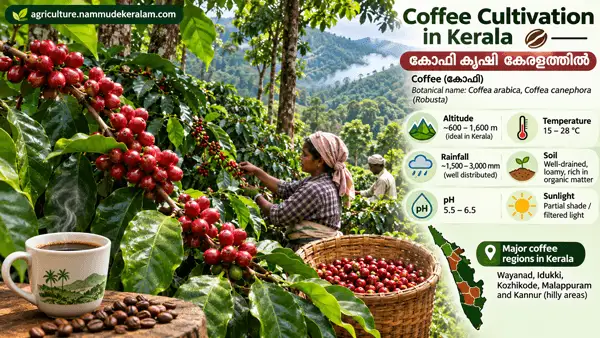
Main commercial coffee region in Keralam: Wayanad
Other established regions: Suitable uplands of Idukki, Nelliyampathy in Palakkad, and the traditional Travancore coffee belt
Research verified: 15 November 2026
Introduction
Coffee is an important plantation crop in Keralam, particularly in Wayanad. It can provide income for many years when planted in suitable soil, under managed shade, with good drainage and sufficient moisture.
Two commercially important types are grown in India:
- Robusta is generally better suited to the warm, humid mid-elevation coffee-growing areas of Keralam. It is the dominant type in Wayanad.
- Arabica requires cooler, higher-elevation conditions. It generally commands a higher price but needs careful disease and pest management.
Coffee is not a quick-return crop. Farmers must invest in planting, shade, soil fertility and labour before substantial harvests begin. Profit also depends heavily on whether the farmer sells properly dried cherry, parchment or cured green coffee.
This guide focuses on Keralam conditions and uses official recommendations wherever possible. Illustrative financial calculations are clearly identified as estimates.
1. Where Can Coffee Grow in Keralam?
Suitable districts and growing areas
| District or region | Suitability | Practical recommendation |
|---|---|---|
| Wayanad — Mananthavady, Sulthan Bathery, Kalpetta and suitable surrounding uplands | Established major coffee belt | Robusta is the main commercial choice |
| Idukki — suitable plantation uplands | Established coffee-growing area | Robusta at suitable elevations; Arabica in selected cooler, higher locations |
| Palakkad — Nelliyampathy hills | Established coffee-growing area | Robusta and selected Arabica, depending on altitude |
| Traditional Travancore coffee belt | Established mixed plantation region | Mainly Robusta, depending on local conditions |
| Other Keralam districts | Site-specific | Do not assume commercial suitability based on district name alone |
The Coffee Board identifies Wayanad and Travancore as traditional coffee-growing regions. KAU specifically recommends S.274 and CxR Robusta for Wayanad, Nelliyampathy and Idukki.
Important: KAU’s 2016 recommendations discourage Arabica cultivation in Wayanad. For selected Arabica-growing sites in Idukki and Nelliyampathy, KAU identifies S.6, Selection 9 and Chandragiri as suitable choices, while discouraging S.795 and Cauvery for those particular regions.
Source: KAU, Package of Practices 2016, Coffee section; Coffee Board growing regions.
Ideal climate and soil requirements
| Requirement | Arabica | Robusta |
|---|---|---|
| Suitable elevation | 1,000–1,500 m above sea level | 500–1,000 m |
| Temperature | 15–25°C | 20–30°C |
| Annual rainfall | 1,600–2,500 mm | 1,000–2,000 mm |
| Relative humidity | 70–80% | 80–90% |
| Shade | Medium to light, managed shade | Uniform, relatively thin managed shade |
| Soil pH | 6.0–6.5 | 6.0–6.5 |
| Soil | Deep, friable, organic-rich | Deep, friable, organic-rich |
| Drainage | Essential | Essential |
Figures: KAU and Coffee Board published growing-condition recommendations.
Coffee grows best in deep, fertile soil with good aeration. A soil containing adequate organic matter helps conserve moisture during dry periods.
Waterlogging is dangerous. Roots require oxygen, and prolonged water stagnation can damage plants and encourage root diseases.
Sunlight and shade
Coffee in India is traditionally grown under shade trees rather than in fully exposed fields.
A managed shade canopy:
- Protects coffee from excessive heat.
- Reduces moisture loss from the soil.
- Supports beneficial organisms.
- Reduces erosion on slopes.
- Helps maintain a more stable plantation microclimate.
However, excessive shade can also cause problems. Very dense vegetation and poor airflow favour certain fungal diseases.
There is no single shade percentage that suits every Robusta and Arabica plantation. Canopy management should depend on altitude, temperature, rainfall, plant age and disease pressure.
Land suitability checklist
Before establishing a plantation, examine the following conditions:
- Is the land within or near the suitable elevation range?
- Can excess monsoon water drain away safely?
- Does the land have adequate shade or space for appropriate shade trees?
- Is the soil deep enough for healthy roots?
- Is irrigation or emergency water available during severe dry spells?
- Is there safe access for workers and harvested coffee?
Avoid planting on unstable slopes, wetlands, poorly drained ground or land where establishing coffee would require unlawful forest clearing.
Farmer recommendation: Obtain a soil test and local Coffee Board field assessment before investing in a new plantation.
2. When Should Coffee Be Planted?
Best planting seasons in Keralam
KAU identifies two important planting windows.
| Planting period | Suitable planting material | Remarks |
|---|---|---|
| June | Suitable rooted plants and field-ready nursery material | Requires appropriate monsoon conditions and drainage |
| September–October | Healthy bag-grown seedlings | Often preferable after the heaviest southwest monsoon rains |
KAU specifically describes planting 16–18-month-old rooted nursery plants and the use of bag plants around September.
The exact date should be selected according to actual rainfall, soil condition and planting-material readiness. Do not plant into waterlogged pits simply because the calendar indicates the monsoon.
Recommended coffee varieties
Robusta
S.274 and CxR are recommended by KAU for the principal Keralam growing regions. CxR means the hybrid between Coffea congensis and Robusta.
These varieties are also included under Keralam’s KERA coffee plantation support programme.
Arabica
Selection 6, Selection 9 and Chandragiri are identified by KAU for selected suitable higher-elevation locations in Idukki and Nelliyampathy. Chandragiri is recommended at approximately 915 metres above sea level and higher, subject to local suitability.
Arabica varieties should not be selected solely because Arabica coffee may command a higher selling price.
Choosing planting material
Buy from a Coffee Board-authorised source, recognised research nursery or other reliable nursery with clear variety identification.
Choose plants with:
- Healthy green leaves and vigorous growth.
- A strong, properly developed root system.
- No twisted, coiled or deformed taproot.
- No visible pest infestation.
- No stem damage or nursery disease.
- Correct variety or clone identification.
For clonal Robusta, also confirm which compatible clones are being supplied.
Important pollination point: Robusta generally requires cross-pollination between genetically compatible plants. A plantation made entirely from one incompatible clone may set fruit poorly. Ask the nursery or Coffee Board extension officer for an appropriate mixed-clone planting design. Arabica is predominantly self-pollinating.
Sources: KAU 2016; World Coffee Research — Robusta.
3. How to Plant Coffee: Step-by-Step Method
A. Propagation and nursery preparation
Coffee is commonly propagated through seeds. Robusta can also be propagated through rooted cuttings, while grafted planting material is used in selected situations.
KAU provides the following nursery guidance:
| Nursery activity | Published recommendation |
|---|---|
| Arabica seed sowing | December–January |
| Robusta seed sowing | February–March |
| Primary nursery bed | Raised approximately 15 cm |
| Nursery medium | Soil:compost in a 6:2:1 ratio |
| Seed spacing in nursery | Approximately 1–1.5 cm |
| Germination | Approximately 40 days under suitable nursery conditions |
| Nursery polybag | Approximately 23 × 15 cm with drainage holes |
Seeds should come from healthy, selected seed-bearing plants. Coffee seeds have limited viability and should be sown soon after procurement.
Nursery soil should remain moist but not waterlogged. Protect young plants from intense afternoon sunlight.
KAU also documents vegetative propagation of Robusta using suitable 10 cm semi-hardwood cuttings. Such cuttings require controlled rooting and hardening; beginners will usually find certified, field-ready plants more practical than establishing a clonal nursery.
These nursery activities precede field planting. Seed sown in February is not automatically ready for field planting that same June.
B. Land preparation
Start with a survey of the plot.
Preserve suitable existing shade trees wherever possible, subject to safe plantation management. Clear unwanted growth without damaging the soil structure.
On slopes, establish contour-based soil conservation measures. Provide access paths that do not concentrate runoff downhill.
KAU recommends opening planting pits in April and allowing them to weather before monsoon planting.
C. Planting pit
Recommended pit size: 45 cm × 45 cm × 45 cm.
Refill with suitable topsoil after weathering. KAU mentions 250 g of well-decomposed FYM or compost per pit for poor soils.
This is a specific pit amendment in the KAU recommendation, not a replacement for a complete long-term organic matter programme.
D. Spacing and plants per acre
| Variety or type | KAU spacing | Approx. theoretical plants/cent | Approx. theoretical plants/acre |
|---|---|---|---|
| Tall Arabica, S.795 type | 2.1 × 2.1 m | 9.2 | 918 |
| Semi-dwarf Arabica, Cauvery type | 1.8 × 1.8 m | 12.5 | 1,249 |
| Dwarf Arabica, San Ramon type | 1.5 × 1.5 m | 18.0 | 1,799 |
| CxR Robusta hybrid | 2.5 × 2.5 m | 6.5 | 647 |
| S.274 Robusta | 3.0 × 3.0 m | 4.5 | 450 |
Plant counts are calculated from the published spacing, using 1 acre = approximately 4,047 m² and 1 cent = approximately 40.47 m². They are not independently measured field populations.
For example, a full acre of S.274 planted in a regular 3 m grid theoretically accommodates around 450 plants. The practical total will be lower when land is used for paths, drains, shade-tree bases and other facilities.
Keralam’s KERA coffee scheme also describes 9 × 9 ft and 10 × 10 ft Robusta planting designs for supported projects. Follow the approved design when applying for a grant rather than automatically using another variety’s spacing.
E. Actual planting procedure
- Prepare and refill the planting pit with suitable topsoil.
- Make a planting hole that accommodates the root system.
- Carefully remove the nursery bag without breaking the root ball.
- Place the seedling upright, with roots in a natural position.
- Refill the soil and firm it gently.
- Keep the planting collar above any standing water.
- Provide appropriate support against wind.
- Apply organic mulch around the planting area, keeping it away from direct contact with the stem.
- Ensure water can drain away from the planting site.
- Inspect the seedling frequently during the establishment period.
KAU recommends maintaining the immediate planting area slightly raised to prevent water stagnation around the collar.
Replace failed plants using healthy material as soon as the local planting season allows.
4. How to Maintain a Coffee Plantation
Irrigation
Water management is one of the most important factors affecting flowering, fruit set and crop yield.
Coffee often depends on rainfall, but dry-season irrigation can improve growth and reduce moisture stress.
KAU recommends using overhead sprinkler irrigation where feasible during November–January to maintain soil moisture and during February–April when blossom and backing irrigation is required.
Blossom irrigation helps trigger flowering when suitable moisture conditions have developed after a dry period.
Backing irrigation supports flower development and early fruit set after blossoming.
The published blossom and backing shower recommendations include:
| Requirement | Arabica | Robusta |
|---|---|---|
| Blossom showers | 25–40 mm, generally March–April | 20–40 mm, generally February–March |
| Backing showers | 50–75 mm, generally April–May | 50–75 mm, with timing varying by region and reference |
These are climatic water requirements, not instructions to apply the entire quantity in a single irrigation.
Irrigation frequency: A reliable Keralam-wide recommendation of a fixed number of litres per plant every fixed number of days was not established from the crop-specific sources reviewed. Irrigation must be scheduled according to soil moisture, rainfall, plant size, shade, available water and flowering stage.
Do not irrigate flowering coffee indiscriminately without understanding local blossom and backing requirements.
Organic manure and soil fertility
The Coffee Board recommends applying FYM or compost at 5 tonnes per hectare once every two years, together with regular soil testing.
This equals approximately 2.02 tonnes per acre every two years when the full recommended area-based quantity is applied.
The Board advises soil testing at least once every two to three years and identifying the need for lime based on soil condition. November is mentioned as a suitable time for lime application.
Do not apply lime automatically without a soil analysis.
Fertiliser recommendations
Coffee fertilisation must consider plant age, expected production, soil nutrient levels, organic inputs and rainfall.
KAU’s 2016 recommendations provide the following annual nutrient quantities for young coffee plants.
| Age | Arabica N:P nutrient dose | Robusta N:P nutrient dose |
|---|---|---|
| Year 1 | 20:10:20 g/plant | 38:28:38 g/plant |
| Year 2 | 20:10:20 g/plant | 38:28:38 g/plant |
| Year 3 | 25:15:25 g/plant | 38:28:38 g/plant |
| Year 4 | 25:15:25 g/plant | 40:30:40 g/plant |
These are nutrient quantities, not weights of an NPK fertiliser bag. The phosphorus and potassium figures follow the conventional fertiliser nutrient notation.
For bearing Robusta, KAU’s earlier 2011 package gives reference annual quantities of:
- Below 1 tonne/hectare crop level: 80:60:80 kg N₂O₅₂O per hectare.
- At or above 1 tonne/hectare crop level: 120:90:120 kg N₂O₅₂O per hectare.
These are published historical reference values. KAU’s 2016 edition provides a more detailed yield-linked fertiliser table. Therefore, the older rates must not be treated as an automatic prescription for a present-day plantation.
The Coffee Board recommends dividing the required fertiliser into suitable applications around the blossom, pre-monsoon and post-monsoon periods. Nutrients supplied through compost and other organic sources must also be considered.
Practical decision: Obtain a current soil-test-based fertiliser schedule from KAU, a Krishi Bhavan or the Coffee Board rather than buying fertiliser solely from a standard table.
Sources: KAU 2016; KAU crop recommendations 2011; Coffee Board planter guidance.
Mulching
Mulching protects soil during hot, dry weather.
Suitable organic materials include dried leaves and clean agricultural residues. Mulch helps conserve soil moisture, suppress weeds and reduce erosion.
Keep mulch from touching the main stem continuously, particularly in wet conditions.
Training and pruning
Coffee bushes require regular training to maintain healthy flowering and fruiting branches.
KAU identifies normal topping heights of:
- Arabica: approximately 75 cm.
- Robusta: approximately 105–120 cm.
These figures apply to specified training systems and should not be used indiscriminately for every existing mature bush.
After harvesting, inspect plants for dead branches, unproductive wood and unwanted shoots. Coffee Board guidance recommends light annual pruning and appropriate centering and removal of unwanted suckers.
Heavy rejuvenation pruning should be planned according to plant age, disease and productive condition.
Intercropping
Coffee can be integrated with other crops in suitable mixed plantations.
The Coffee Board lists black pepper, banana, ginger and vegetables among crops associated with Wayanad coffee plantations.
Black pepper may provide an additional commercial return where suitable support trees already exist. Banana can provide temporary shade and an earlier harvest, but its water and nutrient requirements must also be considered.
Ginger and some vegetables may be suitable during early plantation development if soil disturbance, shading and disease risks are properly managed.
Do not assume every intercrop is profitable or suitable throughout the plantation’s life.
Month-by-month Keralam coffee farming calendar
| Month | Main activities |
|---|---|
| January | Continue Robusta harvesting where ripe; supervise drying and storage; monitor dry-season soil moisture |
| February | Complete suitable Robusta harvests; inspect flowering conditions and blossom irrigation requirements |
| March | Monitor blossom and fruit set; prepare for Arabica and Robusta seasonal nutrient requirements; inspect borer damage |
| April | Prepare new planting pits; protect plants from heat; assess backing irrigation requirements |
| May | Prepare drainage and soil conservation works; organise field planting; assess fertiliser timing in relation to rainfall |
| June | Plant suitable field-ready coffee plants; establish shade and cover crops; prevent erosion |
| July | Inspect young plants; control weeds; remove unwanted suckers; monitor fungal disease |
| August | Monitor berry development, drainage, nutrition and pest incidence |
| September | Plant suitable bag-grown seedlings; monitor shot-hole borer; inspect plant losses |
| October | Carry out suitable post-monsoon nutrient applications and plantation maintenance |
| November | Soil-test and liming activities as indicated; prepare drying infrastructure; begin Arabica harvest where ripe |
| December | Harvest ripe Arabica and early Robusta; sort, dry and store coffee carefully |
This calendar combines KAU and Coffee Board seasonal guidance. Actual flowering and harvesting may move earlier or later with rainfall, altitude, variety and local temperature.
5. When Will Coffee Start Yielding, and How Much?
Time to first harvest
Coffee does not produce a full commercial crop immediately after planting.
A small early crop can develop during the first few productive years. Published international agronomic references describe early bearing from approximately years 2–4, depending on coffee type, propagation material and growing conditions.
For conservative financial planning, farmers should allow several establishment years before expecting substantial revenue. A mature production level should not be assumed for young plants.
A suitable practical interpretation is:
| Plantation stage | Production expectation |
|---|---|
| Years 1–2 | Establishment; no commercial yield assumed in a conservative budget |
| Years 3–4 | Possible early or increasing crop, depending on plant development |
| Years 5–8 | Progression towards stronger mature production under favourable management |
| Mature years | Yield depends on plant health, rainfall, nutrition, shade and pruning |
| Older plantation | Gradual decline or renewal may occur; inspect performance before deciding to replant |
These age ranges are broad planning guidance, not guaranteed Keralam-specific yields for each year.
Harvesting period
The Coffee Board identifies the following main harvest periods:
| Coffee type | General harvest period |
|---|---|
| Arabica | November–January |
| Robusta | December–February |
There may be several picking rounds during one annual harvest season.
Understanding coffee yield correctly
Coffee production figures can be confusing because the product changes weight during processing.
The main forms are:
- Fresh coffee cherry: The ripe fruit picked from the plant.
- Dry cherry coffee: Whole fruits dried using the dry process.
- Parchment coffee: Coffee processed through the wet method and dried with parchment remaining.
- Clean or green coffee: The cured, unroasted coffee bean after removal of the outer material.
For dry cherry processing, Coffee Board research reports an approximate 50–54% outturn of clean coffee from properly dried cherry coffee.
In other words, 100 kg of dry cherry may produce approximately 50–54 kg of clean green beans.
This is not a conversion from 100 kg of freshly picked cherries.
Published production figures for Wayanad
The Government of Keralam’s Industries Department coffee material reports average Robusta productivity of approximately 850 kg/hectare.
Separately, official descriptions of Wayanad Robusta report yield potential of around 1,400 kg/hectare under rainfed conditions and 2,500 kg/hectare under irrigated conditions.
The first is an average productivity reference; the higher figures describe potential under particular conditions. They must not be presented as guaranteed results for every farm.
Estimated annual production per acre and plant
The following table converts those published yield figures to an acre and a theoretical 450-plant S.274-type plantation.
| Published yield basis | Clean coffee per acre (calculated) | Clean coffee per plant (calculated) | Equivalent dry cherry per acre at 52% outturn (calculated) |
|---|---|---|---|
| 850 kg/ha reference average | 344 kg | 0.76 kg | 662 kg |
| 1,400 kg/ha rainfed potential | 567 kg | 1.26 kg | 1,090 kg |
| 2,500 kg/ha irrigated potential | 1,012 kg | 2.25 kg | 1,946 kg |
Important qualifications
- The per-acre and per-plant quantities are calculated illustrations, not individual plant yield observations.
- The table assumes 450 productive plants per acre, without allowing for field paths or missing plants.
- Dry cherry conversion uses the midpoint of the Coffee Board’s published 50–54% outturn range.
- These are whole-season, annual harvest estimates, not quantities from each picking round.
- Fresh cherry weight cannot be reliably calculated here without a verified, crop-specific conversion for the harvesting and processing conditions.
- Irrigated yield potential is not an appropriate default for an ordinary rainfed farm.
For most growers, a conservative yield budget based on local farm history is safer than budgeting for the highest published potential.
Sources: Keralam Industries Department coffee profile; Wayanad district government coffee profile; Coffee Board — September 2019.
Productive lifespan
Coffee can remain productive for decades, but the economically useful period varies with variety, site and management.
The Coffee Board’s replanting guidelines identify old and low-productivity Arabica blocks from about 25 years and Robusta blocks from about 40 years for certain replantation eligibility purposes.
Those ages are scheme eligibility thresholds, not biological death dates or automatic instructions to remove plants.
A healthy older plantation may continue producing, while a younger poorly managed field may require earlier rehabilitation.
6. What Can Go Wrong? Pests, Diseases and Weather Risks
Coffee farmers should inspect plants regularly rather than wait for serious damage.
Important pests and diseases
| Problem | Common warning signs | Safer first response |
|---|---|---|
| Coffee berry borer — Hypothenemus hampei | Small entry holes in berries; damaged beans | Complete timely harvesting, remove leftover and fallen berries, use suitable traps and biological controls |
| White stem borer — Xylotrechus quadripes | Stem ridges, weakening, yellowing and wilting, especially in Arabica | Maintain suitable shade, inspect stems, remove severely infested material, use recommended traps |
| Shot-hole borer — Xylosandrus compactus | Small holes and drying of coffee twigs | Prune affected twigs below the damaged section and remove infested material |
| Mealybugs | White cotton-like insect colonies, weak shoots, ant activity | Inspect closely, manage ants, protect beneficial insects and avoid unnecessary broad-spectrum spraying |
| Coffee leaf rust — Hemileia vastatrix | Yellow-orange powdery spots, particularly under leaves; early leaf fall | Use suitable varieties, maintain plant health and shade, seek locally approved disease treatment when necessary |
| Black rot — Koleroga noxia | Blackened leaves, branches and developing berries during excessively wet conditions | Improve airflow, manage excessive shade and remove infected material |
| Root diseases | Wilting, root decay and declining vigour | Improve drainage, examine root problems and obtain accurate diagnosis |
The Coffee Board includes biological control using Beauveria bassiana for coffee berry borer and lists trapping and plantation sanitation as important control measures.
It also identifies pheromone traps for white stem borer and pruning plus traps for shot-hole borer.
Integrated pest management
ICAR’s September 2026 integrated pest management guidance prioritises prevention, regular monitoring and non-chemical control, with pesticides used only when necessary.
Coffee farmers should follow the same approach:
- Inspect different parts of the plantation routinely.
- Identify the actual pest or disease before treating.
- Remove infested berries and affected plant material safely.
- Maintain suitable shade, drainage and airflow.
- Encourage beneficial organisms.
- Use validated traps or biological products where appropriate.
- Apply chemical treatments only when necessary and currently approved.
Some older published coffee recommendations mention chemicals that may now be restricted or unsuitable. Do not copy an old pesticide formulation, rate or schedule without verifying current Indian registration, crop approval, safety requirements and harvest restrictions.
Consult Coffee Board extension personnel, KAU or the local agriculture office for current crop-specific pesticide advice.
Weather and climate risks
Drought: Insufficient soil moisture can weaken plants and affect flowering, fruit set and subsequent yield. Maintain mulch, conserve soil moisture and plan suitable supplemental irrigation.
Heavy rainfall: Continuous wet conditions may cause soil erosion, waterlogging, landslides on vulnerable terrain and greater fungal disease pressure.
Excessive heat: Inadequate shade can cause heat stress, leaf injury and drying of branches.
Irregular blossom showers: Poorly timed or insufficient moisture around flowering may lead to uneven blossoms and fruit set.
Common farming mistakes
Major preventable mistakes include planting coffee outside suitable climatic conditions, choosing inappropriate varieties, buying unhealthy nursery plants, allowing water to stand around roots, removing too much shade, using excessive fertiliser without a soil test, neglecting pruning and leaving ripe or pest-infested berries on plants after harvest.
A plantation should be managed as a long-term investment, not as a crop that can be neglected for most of the year.
Sources: Coffee Board plant protection guidance; KAU 2016; ICAR Integrated Pest Management, 2026.
7. How to Earn from Coffee Farming
Harvesting for better quality
Harvest coffee when the fruits are properly ripe.
Unripe, overripe, damaged and diseased fruits should be separated where possible.
Do not leave freshly harvested coffee in tightly packed heaps for long periods. Delayed processing encourages deterioration and can reduce quality.
Coffee Board guidance recommends careful fruit selection and clean harvesting and processing equipment.
Dry processing
Dry processing is commonly used for Robusta.
After harvesting:
- Sort out damaged, unripe and overripe fruits.
- Spread suitable ripe cherries on a clean cemented or tiled drying surface.
- During the initial 3–4 days, Coffee Board research recommends a layer not exceeding about 4 cm.
- Subsequently, the layer may be increased to approximately 7–8 cm as drying proceeds.
- Stir and turn the coffee regularly.
- Protect the coffee from night-time moisture and unexpected rain.
- Dry to the recommended moisture standard.
- Clean, grade, pack and store the dried coffee in dry conditions.
Coffee Board guidance for dry cherry processing identifies approximately 11–12% moisture as the drying target.
Wet processing
Wet processing involves pulping ripe fruits, controlled processing of the mucilage, washing and drying the parchment coffee.
The Coffee Board recommends pulping ripe fruits on the day of harvest and maintaining hygienic processing equipment.
Farmers without proper wet-processing facilities should consider using a reliable processor rather than risking fermentation and quality problems through unsuitable equipment or procedures.
Storage
Store dried coffee in clean, ventilated and moisture-protected conditions.
Use raised wooden platforms or equivalent methods to prevent direct contact with a damp floor. Keep coffee away from chemicals, fuel, fertilisers and strong odours.
Avoid rewetting. Do not store coffee for long periods in unsuitable humid conditions.
Where to sell
Farmers may investigate:
- Local coffee traders and aggregators.
- Coffee curing works.
- Coffee processors and roasting businesses.
- Farmer Producer Organisations and cooperatives.
- Specialty coffee buyers, where quality and traceability requirements can be satisfied.
Compare offers on the same product basis. A quote for dry cherry cannot be compared directly with a quote for parchment or fully cured green coffee.
Verified selling-price references
The following quotations were available when checked on 15 November 2026.
| Market and date | Coffee form | Published reference price |
|---|---|---|
| Karnataka Planters’ Association, 12 November 2026 | Robusta dry cherry trade category | ₹9,800–₹10,500 per 50 kg bag |
| Karnataka Planters’ Association, 12 November 2026 | Robusta parchment | ₹17,200–₹18,000 per 50 kg bag |
| Mananthavady APMC, Wayanad, 13 November 2026 | Coffee, reported as Other/Local | ₹21,000 per quintal |
The Karnataka dry cherry reference corresponds to ₹196–₹210/kg of dry cherry.
The Robusta parchment reference corresponds to ₹344–₹360/kg of parchment.
The Mananthavady quotation corresponds to ₹210/kg for the reported market category. That report does not adequately establish whether its grade is equivalent to the dry cherry quotation, so it must not be treated as an identical product price.
These are dated market references, not guaranteed farm-gate payments. Transport, grading, moisture, outturn, deductions, dealer margins and actual lot quality can change the price received.
Sources: Karnataka Planters’ Association; Wayanad Agmarknet-derived market records; Coffee Board market information.
One-acre coffee farming cost estimate
All following cost figures are illustrative budgeting assumptions, not verified November 2026 supplier or labour quotations. Obtain actual prices locally before investing.
Example: Initial establishment cost
Assume one acre of Robusta with approximately 450 plants, some existing usable shade, and basic irrigation facilities.
| Expense | Illustrative cost |
|---|---|
| 450 planting materials at an assumed ₹80 each | ₹36,000 |
| Pit digging and planting labour | ₹28,000 |
| Soil preparation, manure and compost | ₹18,000 |
| Additional shade-tree establishment | ₹10,000 |
| Drainage and erosion control | ₹15,000 |
| Basic irrigation arrangement | ₹20,000 |
| Transport, replacements and contingency | ₹15,000 |
| Total initial setup | ₹1,42,000 |
This is a sample project budget only. Existing infrastructure, terrain, plant quality, labour availability and irrigation requirements can substantially change the amount.
The Coffee Board/KERA programme separately uses a ₹2,75,000 per hectare unit-cost reference for certain Robusta planting support calculations. That is an administrative scheme norm, not a quotation for every real-world farm.
Land purchase, lease charges, major infrastructure, borrowing costs and several years of establishment-period maintenance are excluded from this example.
Example: Annual maintenance and harvesting budget for a bearing acre
| Expense | Illustrative annual cost |
|---|---|
| Pruning, shade management and weeding | ₹20,000 |
| Soil fertility, manure and fertiliser | ₹17,000 |
| Irrigation and water-system maintenance | ₹8,000 |
| Harvesting labour | ₹25,000 |
| Drying, sorting, bags and transport | ₹12,000 |
| Small repairs and contingency | ₹8,000 |
| Total operating cost | ₹90,000 |
These assumed costs should be replaced with a farm-specific budget. Harvesting and processing expenses generally change as crop volume changes.
Example annual profit or loss
The model assumes an established one-acre Robusta plantation, sold as properly dried cherry. It excludes loan interest, depreciation, land cost, establishment-year losses, taxes and owner-management remuneration.
| Scenario | Dry cherry sold | Assumed price/kg | Gross revenue | Assumed annual cost | Operating surplus or loss |
|---|---|---|---|---|---|
| Stress case | 400 kg | ₹180 | ₹72,000 | ₹90,000 | −₹18,000 |
| Reference-average case | 662 kg | ₹196 | ₹1,29,752 | ₹90,000 | ₹39,752 |
| Strong rainfed case | 1,090 kg | ₹200 | ₹2,18,000 | ₹90,000 | ₹1,28,000 |
The 662 kg and 1,090 kg dry cherry quantities are calculated from the published clean-coffee yield references and an assumed 52% dry-cherry-to-clean-coffee outturn.
The ₹196 and ₹200 price assumptions are within the dated Karnataka Robusta dry cherry reference range. The ₹180 stress price is an intentionally lower hypothetical selling price, not an observed November 2026 quotation.
This model does not establish the actual profitability of a Keralam coffee plantation. Higher crop volumes may increase labour and processing costs, while poor quality may reduce real selling prices.
The example also excludes the period before substantial bearing, during which farmers must spend on plantation maintenance without receiving equivalent coffee revenue.
A full investment decision should include cash flow for the establishment years, working capital, replacement plants, borrowing costs and the value of the land.
Break-even calculation
With an assumed annual operating expense of ₹90,000 and a selling price of ₹200/kg of dried cherry:
Break-even dry cherry quantity = ₹90,000 ÷ ₹200 = 450 kg/year.
This is only an operating break-even point. It does not recover initial establishment expenditure or provide a return on the farmer’s land and capital.
Other income opportunities
Pepper grown on suitable supports, appropriate banana cultivation, other carefully chosen intercrops and quality-based coffee marketing may improve total plantation income.
However, intercrop income is not included in the example calculations. It should be recorded separately along with the additional costs.
8. Government Support and Financial Assistance
Keralam KERA Coffee Schemes
The Government of Keralam’s KERA plantation programme provides a dedicated online coffee scheme system, mainly focused on eligible Wayanad applicants.
The official portal describes the following support components.
| Support component | Published support or conditions |
|---|---|
| Robusta replantation | 40% of approved ₹2.75 lakh/hectare unit cost, amounting to ₹1.10 lakh/hectare for eligible applicants |
| New Robusta plantation | Up to ₹1.10 lakh/hectare on the stated eligibility basis |
| Irrigation support | Published assistance for eligible water-storage structures and sprinkler systems, subject to project conditions |
| Certified nursery development | Up to 60% of approved project cost, subject to a maximum ₹6 lakh per eligible nursery |
| Eco-certification | Reimbursement of 75% of eligible certification cost, subject to a maximum ₹2 lakh |
For new planting and replanting, the KERA portal specifies eligible holdings from 0.10 to 10 hectares, together with ownership, location, field verification and other requirements.
The programme includes technical feasibility checks, training and inspection before eligible grant payments.
Important: A published scheme does not guarantee that funding is currently open, allocated or approved for a specific farmer.
Do not begin expensive project activities on the assumption that a grant will automatically be received. Confirm the applicable application window, required prior approvals and current guidelines.
Official portal: https://keraplantation.kerala.gov.in/public/index.php/coffee_overview
Coffee Board support
The Coffee Board operates extension services and publishes Integrated Coffee Development Project guidelines. Certain scheme guidelines address replantation, infrastructure and coffee-sector development.
Applicants should check the latest applicable financial-year notifications and eligibility rules rather than relying on older subsidy percentages.
Official links:
Where farmers should seek technical guidance
For variety selection, soil testing, planting material, pest control and fertiliser schedules, contact the appropriate Coffee Board liaison or extension office, local Krishi Bhavan, KAU or relevant KVK.
Keep records of land ownership, planted area, planting material, soil tests, invoices and photographs.
9. Five Frequently Asked Questions
1. Can coffee be grown in every district of Keralam?
Not commercially under identical conditions. Coffee needs the correct combination of elevation, temperature, moisture, soil and shade. Wayanad is the principal established region, and suitable upland areas in Idukki, Nelliyampathy and the traditional Travancore belt also support coffee cultivation.
Low-elevation or poorly drained land should not be assumed suitable without technical assessment.
2. Which is better for Keralam: Arabica or Robusta?
For much of Wayanad, Robusta is the established commercial choice. Arabica may be suitable in selected cooler higher-elevation locations, particularly in parts of Idukki and Nelliyampathy.
Select the crop based on climate, local disease pressure and verified variety suitability rather than coffee selling price alone.
3. How many Robusta coffee plants can be planted on one acre?
At KAU’s 3 m × 3 m spacing for S.274, the theoretical capacity is approximately 450 plants per acre.
CxR planted at 2.5 m × 2.5 m has a theoretical capacity of around 647 plants per acre.
Actual planting numbers will be affected by shade trees, pathways, drains and usable planting area.
4. How much coffee can one plant produce every year?
There is no reliable universal kg-per-plant figure.
Using published field productivity references and a theoretical 450-plant acre, the calculated annual average can range from approximately 0.76 kg of clean coffee per plant at the 850 kg/hectare reference to about 1.26 kg per plant at the 1,400 kg/hectare yield-potential level.
These are mathematical averages, not a guarantee from any individual plant.
Young plants generally yield less than established productive plants.
5. Is one acre of coffee farming profitable?
It can be profitable under favourable conditions, but income is not guaranteed.
Profit depends on production, selling price, labour, processing quality, water availability and annual costs.
A new coffee plantation also requires several years of spending before it earns substantial returns. Farmers should prepare a multi-year budget rather than evaluating the investment from one mature-year profit example.
10. Farmer Checklist Before Starting Coffee Cultivation
- Confirm that the farm has suitable altitude and climate.
- Test the soil, including pH and important nutrients.
- Assess drainage, erosion risk and water availability.
- Consult the Coffee Board or qualified local agriculture officer.
- Choose a recommended variety suitable for the location.
- Obtain healthy and traceable planting materials.
- Confirm compatible polliniser material for clonal Robusta.
- Plan shade trees, field access and drainage.
- Select the appropriate planting window.
- Prepare pits using the recommended spacing and pit dimensions.
- Budget for multiple years before substantial harvests.
- Obtain a soil-test-based nutrient schedule.
- Plan harvest labour and safe drying infrastructure.
- Identify potential buyers and obtain comparable price quotations.
- Check eligibility and approval requirements for available schemes.
- Maintain planting, expense, yield and sales records.
Conclusion
Coffee cultivation can provide long-term income in suitable parts of Keralam, especially in established Robusta-growing areas such as Wayanad.
The most important decisions are selecting a suitable location and variety, protecting the crop from waterlogging and drought, maintaining good soil fertility, managing shade and harvesting high-quality coffee.
Farmers should use verified local production data and actual selling prices before estimating profit. A healthy plantation with good processing and marketing can perform well, but coffee is a long-term agricultural investment with genuine weather, market and operating risks.
Direct Sources and Research References
- Keralam Agricultural University (2016), Package of Practices Recommendations: Crops, 15th edition. Coffee chapter, printed pages 167–175. Includes climate, varieties, planting, nursery management, fertiliser guidance, pruning and pest control.
- Keralam Agricultural University (2011), Package of Practices Recommendations: Crops. Historical fertiliser recommendation tables and coffee cultivation guidance.
- Coffee Board of India, Coffee Growing Regions. Growing conditions, regional characteristics, major varieties and cropping systems.
- Coffee Board of India, Planter Agronomic Practices. Soil conservation, shade, pruning, soil testing, nutrients, pests and post-harvest management.
- Government of Keralam, Wayanad District — Wayanad Robusta Coffee. Regional coffee identity and published yield potential.
- Government of Keralam, Industries Department — Wayanad Coffee Product Profile. Regional production and productivity references.
- Coffee Board, Indian Coffee, September 2019. Central Coffee Research Institute research on dry cherry and parchment outturn.
- Coffee Board, Indian Coffee, November 2020. Good Management Practices for the Production of Quality Coffee during Dry Processing.
- Coffee Board, Indian Coffee Sustainability Standard and Certification Scheme (2026). Shade, soil conservation, nutrient management and environmental practices.
- Government of Keralam, KERA Coffee Schemes. New plantation, replanting, irrigation, nursery and certification assistance, with eligibility details.
- Coffee Board, Integrated Coffee Development Project (2024–2026 guidelines). Historical official replanting eligibility and scheme arrangements. Check updated financial-year provisions separately.
- Karnataka Planters’ Association, Market Prices. Robusta cherry and parchment quotations dated 12 November 2026. Indicative regional market figures, not guaranteed Keralam transaction prices.
- Wayanad Coffee Market Records, derived from Agmarknet. Coffee market quotations including Mananthavady on 13 November 2026. Product-grade comparability must be checked.
- Indian Council of Agricultural Research (22 September 2026), Integrated Pest Management: A Sustainable Approach to Responsible Pest Management. General IPM principles rather than coffee-specific chemical recommendations.
- World Coffee Research, History of Robusta. Robusta cross-pollination and the importance of genetically diverse, compatible planting material.
- CIRAD, Coffee: Plant and Uses. Coffee biology, propagation and broad bearing-age information.
Editorial evidence note: Cultivation figures are attributed to their published sources. Calculated plant populations, dry-cherry equivalents, expense budgets and profit scenarios are illustrative. A verified current Keralam-wide fresh-cherry-to-clean-bean conversion, universal irrigation interval, consistent yield per picking round and farm-level cost survey were not established, so no exact recommendations are invented for those items.
Agricultural practices vary by crop, season and location. Use this guide as a reference, and check available sources and local conditions before making decisions.
Knowledge grows when we share it.
Nammude Keralam
Nammude Keralam
Share this article with another grower or farming enthusiast.