At a glance
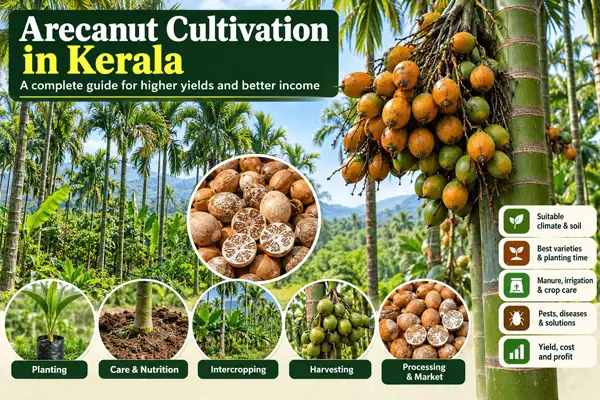
Complete Farming Guide Arecanut is an important plantation crop grown in Keralam, particularly in humid coastal areas, midlands and suitable foothill regions.…
In this article
50 sections to explore
Complete Farming Guide
- Malayalam name: അടയ്ക്ക (Adakka)
- Arecanut palm: കമുക് (Kamuku)
- Botanical name: Areca catechu L.
- Family: Arecaceae
- Common English names: Arecanut, Areca Palm, Betel Nut
- Region: Keralam, India
- Last researched and checked: 31 October 2026
Arecanut is an important plantation crop grown in Keralam, particularly in humid coastal areas, midlands and suitable foothill regions. Its nuts are sold fresh, ripe, dried or processed according to market demand.
Arecanut farming requires long-term planning. Unlike vegetables, farmers must maintain the palms for several years before obtaining a substantial harvest. Good planting material, adequate irrigation, drainage, soil fertility and protection from diseases are essential.
This guide explains how to establish and maintain an arecanut plantation, when to harvest, how to estimate production and how to understand the costs and income.
Important: The crop figures below come primarily from Keralam Agricultural University (KAU), ICAR-Central Plantation Crops Research Institute (CPCRI), and Keralam government statistics. Research yields, actual farm yields, historical costs and example calculations are identified separately.
1. Where Can Arecanut Grow in Keralam?
Suitable districts and regions
Arecanut can be cultivated in suitable parts of all 14 Keralam districts, provided the soil, climate, drainage and irrigation are favourable.
Important growing regions include:
- Kasaragod: Coastal, midland and suitable interior plantation areas.
- Kannur: Humid midlands, coastal regions and suitable eastern foothills.
- Kozhikode: Midland and foothill areas with well-drained soil.
- Wayanad: Suitable warm, humid areas with adequate irrigation and drainage.
- Malappuram: Humid midlands and suitable upland regions.
- Thrissur and Palakkad: Suitable garden lands where dry-season irrigation is available.
- Ernakulam, Kottayam, Pathanamthitta and Idukki: Suitable humid garden lands and lower-elevation areas, subject to local soil and climatic conditions.
- Alappuzha, Kollam and Thiruvananthapuram: Well-drained locations with adequate water management.
These are broad suitability descriptions, not district-wide guarantees. Low-lying, waterlogged plots and exposed, drought-prone sites may be unsuitable even within established growing districts.
In high-rainfall districts, drainage is especially important. In drier areas, the availability and cost of irrigation may determine whether commercial cultivation is worthwhile.
Climate requirements
ICAR-CPCRI publishes the following crop-specific conditions:
| Factor | Recommendation |
|---|---|
| Climate | Humid tropical |
| Altitude | From near sea level to approximately 1,000 metres |
| Favourable temperature | 14°C–36°C |
| Documented temperature tolerance | Approximately 4°C–40°C |
| Rainfall | Abundant and well distributed |
| Soil pH | 5.2–7.0 |
| Soil | Laterite, red loam and alluvial soils |
| Drainage | Essential; avoid prolonged waterlogging |
Rainfall needs careful interpretation.
CPCRI reports that arecanut can grow where annual rainfall exceeds 4,500 mm and may survive in areas receiving approximately 750 mm if irrigation is available. These figures describe a wide range of observed conditions, not an equally productive or recommended rainfall range.
The important requirements are sufficient moisture, dependable irrigation in dry months, and a healthy root zone.
Source: ICAR-CPCRI, Calendar for Arecanut, Technical Bulletin No. 67.
Sunlight and shade
Arecanut needs light for healthy growth and production, but young plants are sensitive to strong direct sunlight.
During establishment:
- Provide partial shade for young seedlings.
- Protect the southern and western sides of the plantation against hot afternoon sunlight.
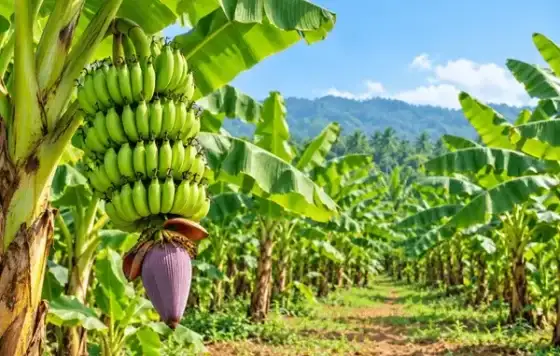
- Banana can serve as a temporary shade crop.
- Avoid permanently dense shade that restricts palm growth.
- Protect exposed stems from summer sun scorching.
KAU recommends banana shade during the initial four to five years where appropriate.
Suitable soil
Arecanut grows best in deep, fertile, well-drained soil.
Lateritic soils are common in Keralam, but they may require improvements in organic matter, moisture retention and fertility.
Red loam and suitable alluvial soils can also support the crop.
Before planting, check:
- Whether rainwater remains standing after heavy showers.
- Whether the soil is sufficiently deep for root development.
- Whether the soil becomes excessively dry during summer.
- Whether soil acidity and nutrient levels need correction.
- Whether drainage channels can safely carry excess rainwater away.
Farmer recommendation: Obtain a soil test from a recognised laboratory or through your local Krishi Bhavan before investing in a large plantation.
Source: KAU Package of Practices, 2016; ICAR-CPCRI crop production recommendations.
2. When Is the Best Time to Plant Arecanut?
Recommended planting months
KAU provides two main planting windows:
| Soil or growing condition | Planting season |
|---|---|
| Well-drained soil | May–June |
| Clayey or higher-moisture soil | August–September |
May–June planting coincides with the beginning of Keralam’s southwest monsoon.
August–September planting is recommended for clayey soils where planting during heavy early monsoon rainfall may cause waterlogging.
These windows should be adjusted according to actual rainfall, field drainage and local advice.
Do not plant during intense rainfall if water is standing in the pits.
Which varieties are suitable for Keralam?
ICAR-CPCRI has developed and evaluated several improved varieties.
| Variety | Growth type | Published average dry kernel yield |
|---|---|---|
| Mangala | Semi-tall | 2.90 kg/palm/year |
| Sumangala | Tall | 3.28 kg/palm/year |
| Sreemangala | Tall | 3.18 kg/palm/year |
| Swarnamangala | Tall | 3.88 kg/palm/year |
| Mohitnagar | Tall | 3.67 kg/palm/year |
These values are published variety performance figures, not guaranteed farm yields.
The listed varieties have published recommendations covering Keralam or coastal Keralam. Mangala is known for relatively early bearing and a shorter stature than traditional tall types.
KAU also lists the dwarf hybrids VTLAH-1 and VTLAH-2. Their suitability and planting-material availability should be confirmed with a recognised nursery.
Other traditional types include Kasaragod Local and South Kanara Local in suitable North Keralam growing areas.
How to choose: Ask the nursery whether the variety is suited to your district, altitude, irrigation conditions and intended market—ripe nuts, dried kernels or tender processed nuts.
Source: ICAR-CPCRI, Improved Varieties of Arecanut.
3. How to Select Good Seed Nuts and Seedlings
Arecanut is commonly propagated through seeds. Ordinary commercial field establishment uses seedlings rather than grafts.
Selection of mother palms
For farmers producing their own seedlings, select seed nuts from palms with:
- Regular, consistently good production.
- Healthy crowns and strong growth.
- Good fruit setting.
- No serious pest or disease symptoms.
- Desirable nut size and quality.
- A known history of satisfactory performance.
CPCRI’s elite mother-palm criteria include palms older than 12 years, with consistent production of approximately 3 kg or more of dry kernel per year and good fruit setting.
Selection of seed nuts
Choose fully ripe, well-developed seed nuts from the middle bunches of healthy mother palms.
CPCRI reports that seed nuts weighing more than 35 g are associated with better germination and seedling performance.
Discard damaged, malformed, undersized and diseased nuts.
Seed nuts should be sown quickly after harvesting because they lose viability during storage.
Nursery preparation
Primary nursery
- Select a well-drained nursery location.
- Prepare sand or suitable nursery beds.
- Place seed nuts with the stalk end pointing upward.
- Maintain approximately 5–6 cm spacing.
- Cover the nuts with sand or suitable nursery material.
- Provide shade.
- Water regularly without creating stagnant conditions.
- Remove diseased and damaged sprouts.
CPCRI reports that germination commonly starts around 45 days and may continue until approximately 95 days under suitable nursery conditions.
Secondary nursery
Move healthy sprouts at approximately three months after sowing.
KAU recommends:
- Bed width: 150 cm.
- Seedling spacing: 30 cm × 30 cm.
- Well-decomposed cattle manure: 5 tonnes per hectare of nursery area.
- Partial shade.
- Regular irrigation and drainage.
Healthy seedlings may also be raised in suitable polybags with drainage holes.
Selecting seedlings for field planting
KAU recommends selecting healthy seedlings approximately 12–18 months old.
Look for:
- Vigorous growth.
- Strong collar and stem.
- Healthy green leaves.
- A good root system.
- No leaf spot, collar rot or visible pest infestation.
- No damaged growing point.
Buy labelled planting material from a reputable nursery or recognised agricultural institution.
Do not assume that every seedling sold under an improved-variety name has verified parentage.
4. How to Plant Arecanut Step by Step
Land preparation
Clear unnecessary weeds and obstacles while retaining useful vegetation that protects soil from erosion.
Identify natural drainage paths.
On sloping land, use contour measures, bunds or suitable terraces to reduce erosion without causing water to collect around palms.
Mark the planting points before digging.
Spacing
The standard spacing recommended by KAU and CPCRI is:
2.7 metres × 2.7 metres
At this spacing, the theoretical planting population is approximately:
| Area | Number of palms |
|---|---|
| 1 cent | 5.55 |
| 10 cents | 55 |
| 25 cents | 139 |
| 50 cents | 278 |
| 1 acre | 555 |
| 1 hectare | 1,372 |
These are mathematical grid capacities, not guaranteed numbers of planting positions.
Actual planting numbers will be lower where space is reserved for paths, drains, buildings, field boundaries or existing trees.
For example, a farmer may have fewer than 555 palms on one acre because of practical field layout.
Pit size
KAU’s standard recommendation is:
60 cm × 60 cm × 60 cm
CPCRI also provides soil-specific recommendations:
| Soil condition | CPCRI pit recommendation |
|---|---|
| Lateritic soil | 90 × 90 × 90 cm |
| Red soil | 75 × 75 × 75 cm |
| Heavy soil or high water table | Shallower pits of approximately 60 cm, or 45 cm depth where appropriate |
The two institutions’ figures should not be treated as contradictory: KAU gives a general field recommendation, while CPCRI identifies soil-dependent adjustments.
In poorly drained land, reducing pit depth alone may not solve waterlogging. Drainage and the suitability of the land must be assessed first.
Planting procedure
Step 1 — Mark rows
Maintain the recommended spacing.
KAU recommends approximately north–south alignment, with a 35° deflection towards the west to help reduce sun scorching.
Step 2 — Dig the pits
Separate topsoil from less fertile soil.
Allow the pits to weather before planting where conditions permit.
Step 3 — Prepare the planting mixture
Use fertile topsoil and well-decomposed organic manure.
CPCRI’s seasonal field guidance mentions 5–10 kg of farmyard manure while preparing planting pits. This is a planting-stage recommendation, separate from the annual manure programme.
Step 4 — Position the seedling
Carefully remove the polybag without disturbing the root ball.
Place the seedling in the centre of the pit.
Keep the collar at the correct soil level. Do not bury the growing point.
Step 5 — Fill and firm the soil
Fill with suitable soil and press gently around the root ball.
Step 6 — Water if necessary
Provide sufficient moisture for establishment without waterlogging.
Step 7 — Mulch and shade
Apply suitable organic mulch around the plant.
Provide temporary protection against strong sunlight, especially from the southwest.
Step 8 — Inspect regularly
Replace failed seedlings when planting conditions are suitable.
Pay particular attention to drainage during the first monsoon and moisture availability during the first summer.
Sources: KAU Package of Practices, 2016; ICAR-CPCRI Research Achievements.
5. How to Maintain an Arecanut Plantation
Irrigation
Arecanut requires reliable soil moisture.
KAU gives the following seasonal guidance for west-coast plantations under basin or hose irrigation:
| Period | Irrigation interval |
|---|---|
| November–December | Approximately once every 7–8 days |
| January–February | Approximately once every 6 days |
| March–May | Approximately once every 3–5 days |
KAU recommends approximately 175 litres per adult palm per irrigation under the described system.
ICAR-CPCRI also reports a recommendation of 200 litres per palm once in six days under tested conditions.
These quantities refer to particular irrigation methods and conditions. They are not instructions to apply the same volume during every rainy or cool period.
Drip irrigation
CPCRI reports a drip irrigation rate of approximately:
20 litres per palm per day under the recommended dry-season conditions.
Drip irrigation can improve water-use efficiency.
However, actual irrigation requirements depend on soil moisture, rainfall, soil depth, age of palms and local evaporation.
Young plants and mature palms should not automatically receive identical irrigation volumes.
Annual manure recommendation
KAU recommends the following organic materials:
| Organic input | Recommended annual quantity |
|---|---|
| Green leaves | 12 kg/palm |
| Compost or farmyard manure | 12 kg/palm |
Apply from the first year onwards, normally during September–October.
For a plantation with 500 palms, the full annual organic-material requirement would be:
- Green leaves: 6,000 kg.
- Compost/FYM: 6,000 kg.
These quantities are substantial. Farmers should check material availability, transport and labour costs before planting.
Chemical fertiliser recommendations
The published annual recommendation for an adult palm is:
| Nutrient | Annual amount per palm |
|---|---|
| Nitrogen (N) | 100 g |
| Phosphate (P₂O₅) | 40 g |
| Potash (K₂O) | 140 g |
These are quantities of plant nutrients, not weights of fertiliser products such as urea or muriate of potash.
The exact quantity of fertiliser product must be calculated using its nutrient concentration.
Fertiliser quantity by plant age
| Age after planting | Recommended proportion |
|---|---|
| First year | One-third of full dose |
| Second year | Two-thirds of full dose |
| Third year onwards | Full recommended dose |
This is the general age-based schedule, subject to soil-test recommendations.
When to apply
KAU recommends:
- Irrigated plantations: September–October and February.
- Rainfed plantations: September–October, with the second dose in March–April after adequate summer rain.
CPCRI’s seasonal calendar also describes pre-monsoon and post-monsoon nutrient application schedules.
Select one locally appropriate schedule with the agricultural officer. Do not combine two different schedules and accidentally double the fertiliser.
Apply nutrients around the root-feeding zone and incorporate them gently into the soil.
KAU specifies basins approximately 15–20 cm deep at a radius of 75 cm to 1 metre for established palms.
Avoid damaging roots.
Liming acidic soil
KAU’s general recommendation for acidic soils is approximately 0.5 kg lime per palm once every two to three years.
The actual need depends on soil testing.
Do not apply lime routinely without checking soil acidity, especially if the soil is already within a suitable pH range.
Mulching
Organic mulch helps:
- Reduce evaporation.
- Protect soil from excessive heat.
- Improve soil structure as it decomposes.
- Reduce weed growth.
- Support soil biological activity.
Suitable materials include dry arecanut leaves, chopped plant residues, composted organic matter and other clean organic mulch.
Avoid piling wet mulch directly against the palm collar.
Weeding and pruning
Remove weeds that compete with young palms for water and nutrients.
Use light cultivation near the roots.
Remove dead or seriously diseased fronds when necessary.
Do not remove healthy green leaves unnecessarily.
Arecanut does not require heavy canopy pruning or branch training like many fruit trees. Excessive leaf removal can reduce the plant’s capacity for growth and production.
Pollination
Arecanut produces male and female flowers on its inflorescences.
It is a naturally cross-pollinated crop.
For ordinary commercial cultivation, farmers generally do not need to carry out artificial pollination.
CPCRI describes hand-pollination techniques primarily for controlled breeding and hybrid seed production.
Avoid unnecessary damage to developing inflorescences.
Intercropping
KAU identifies several crops that can be integrated with arecanut plantations, depending on shade, moisture and local growing conditions.
These include:
- Banana.
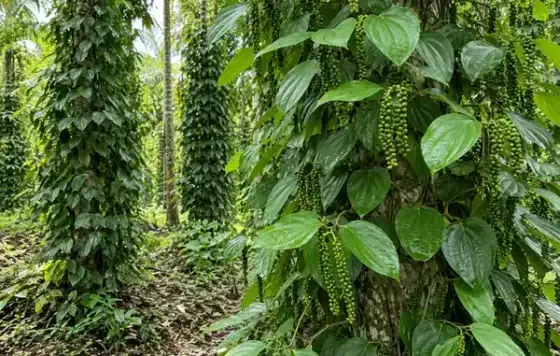
- Black pepper.
- Cocoa.
- Ginger.
- Elephant foot yam.
- Pineapple.
- Betel vine.
- Cardamom in suitable conditions.
Turmeric and some other annual crops may also be suitable in young plantations.
Banana is particularly useful as a temporary shade crop.
Cocoa may be suitable in established arecanut-based cropping systems.
Intercrops need their own nutrient and irrigation management. Do not expect the arecanut manure programme to support all intercrops automatically.
Intercropping can provide income while the arecanut palms are still young, but the financial benefit must be calculated separately.
6. Month-by-Month Arecanut Farming Calendar for Keralam
The following calendar is adapted from ICAR-CPCRI’s arecanut calendar and KAU recommendations.
It is a practical seasonal guide. Actual rainfall, flowering, maturity and field conditions must take priority.
| Month | Important farm activities |
|---|---|
| January | Irrigate during dry weather; maintain nursery shade; continue harvesting and drying ripe nuts where ready; inspect inflorescences for pests. |
| February | Continue irrigation and mulching; inspect for sun scorch and inflorescence dieback; apply scheduled fertiliser in irrigated gardens under the KAU programme. |
| March | Increase attention to irrigation and moisture conservation; protect young palms from heat; inspect for mites and other summer pests. |
| April | Prepare new planting land and drainage plans; maintain irrigation; begin green-manure preparation when conditions allow. |
| May | Dig planting pits; arrange healthy seedlings; prepare for monsoon planting; inspect and protect against pre-monsoon disease risks. |
| June | Plant in well-drained land after suitable monsoon rains; provide shade and mulch; clean drains; monitor fruit rot. |
| July | Maintain drainage; inspect for bud rot and fruit rot; replace failed seedlings when appropriate; keep nursery beds healthy. |
| August | Inspect disease symptoms; manage drainage and erosion; tender-nut harvesting may begin in suitable production systems. |
| September | Plant in suitable clayey or high-rainfall locations after heavy rains subside; apply scheduled manure and fertiliser; incorporate green-manure crops. |
| October | Complete post-monsoon nutrient application; control weeds; improve soil conditions; inspect roots and palm health. |
| November | Resume dry-season irrigation as needed; protect exposed palms from sun scorch; select seed nuts; harvesting of ripe nuts for dry-kernel processing may begin. |
| December | Continue harvesting, drying and grading ripe nuts; maintain irrigation and nursery care; prepare seed nuts for propagation. |
Important: This is not a guarantee that every plantation flowers or produces marketable nuts in the same month.
The local growing environment, age of the palm and product being harvested determine the actual schedule.
Source: ICAR-CPCRI, Calendar of Operations for Arecanut.
7. When Does Arecanut Start Producing?
Arecanut is a long-duration plantation crop.
First flowering and commercial production
CPCRI reports that some improved varieties begin flowering approximately four to five years after planting under good management.
Mangala can flower relatively early.
However, flowering does not mean that the palm has reached full commercial production.
A plantation normally passes through several stages:
| Plantation stage | Approximate age |
|---|---|
| Pre-bearing | Years 1–4 |
| Initial bearing | Years 5–15 |
| Increasing yield | Approximately years 15–25 |
| Stabilised mature production | Approximately years 26–40 |
| Possible declining production | Often after approximately 45 years |
These stages are taken from CPCRI’s published economic-life assessment. They describe broad production phases rather than guaranteed age-specific output.
Some well-managed palms may remain productive beyond these periods, while diseased, drought-affected or poorly managed palms may decline earlier.
Flowering and harvest season
Flowering and fruit development vary with local conditions.
CPCRI records approximately 11–12 months from pollination to fully mature seed nuts.
For product-specific harvesting:
- Tender nuts for processing may be harvested from approximately August onward in suitable systems.
- Harvesting for ripe, dried-kernel production commonly begins around November.
- Ripe-nut harvesting and drying may continue through December and January and sometimes later, depending on crop maturity.
Do not harvest unripe nuts for a market that requires fully mature dry kernels.
8. How Much Arecanut Can One Palm Produce?
This is one of the most important questions for a farmer.
Production must be measured correctly.
There are three different quantities:
- Number of fresh nuts harvested.
- Weight of fresh nuts.
- Weight of dry processed kernels, called chali.
They must not be treated as interchangeable.
Published improved-variety yields
ICAR-CPCRI reports the following annual dry kernel yields:
| Variety | Dry kernel per mature palm/year |
|---|---|
| Mangala | 2.90 kg |
| Sumangala | 3.28 kg |
| Sreemangala | 3.18 kg |
| Swarnamangala | 3.88 kg |
| Mohitnagar | 3.67 kg |
These figures come from published variety evaluations. Actual production can be lower because of soil constraints, disease, drought, palm age or poor management.
Fresh nuts per palm
CPCRI’s selection criteria for elite mother palms include approximately 350–400 fresh nuts per palm annually.
This is an elite mother-palm selection benchmark, not a typical or guaranteed yield for every arecanut palm in Keralam.
How much can one acre produce?
At standard spacing, an acre can theoretically accommodate approximately 555 palms.
The following table is a mathematical illustration using the published variety yields.
| Variety | Assumed palms | Calculated annual dry kernel output |
|---|---|---|
| Mangala | 555 | 1,610 kg |
| Sumangala | 555 | 1,820 kg |
| Sreemangala | 555 | 1,765 kg |
| Swarnamangala | 555 | 2,153 kg |
| Mohitnagar | 555 | 2,037 kg |
These are calculated figures, not observed average yields per acre in Keralam.
They assume every one of the 555 palms survives, reaches the stated variety performance and produces the published average.
In real plantations, usable space, non-bearing palms, plant losses, disease and differences in management reduce actual production.
Farmers should use their own records or comparable local farms to prepare investment forecasts.
Young versus mature palms
New plantations produce no saleable arecanut until bearing begins.
Initial crops may be smaller and variable.
As palms develop, yield can increase, although the rate differs between varieties and environments.
The published adult variety yields must not be applied automatically to young bearing palms.
Yield per harvest
Arecanut may be harvested in more than one picking or round.
There is no reliable single kilogram figure per palm per harvest that applies across Keralam.
The quantity harvested in a round depends on the maturity and number of bunches ready for cutting.
For accurate records, calculate:
Dry kernel production per harvest = Total dry kernel weight obtained from that harvest.
Annual production per palm = Total dry kernel production for the year ÷ Number of bearing palms.
Measure each round separately rather than dividing the expected annual yield equally between harvests.
9. Important Pests and Diseases
Arecanut can suffer serious losses from fungal diseases, root pests, insects and environmental stress.
Early diagnosis is essential because several different problems cause yellowing or drying of leaves.
1. Fruit rot or Mahali (Koleroga)
Cause: Phytophthora species.
Typical symptoms
- Water-soaked or brown lesions on fruits.
- Rotting nuts.
- Premature nut fall.
- Damage becoming severe during wet monsoon conditions.
- Dried or mummified diseased nuts.
Management
- Keep drainage channels open.
- Collect and remove infected fallen nuts.
- Reduce sources of infection in the plantation.
- Inspect fruit bunches before and during the southwest monsoon.
- Follow locally recommended preventive treatment when disease risk is high.
KAU and CPCRI recommend 1% Bordeaux mixture for protecting bunches in disease-prone conditions, with application before the monsoon and repeat treatment based on the recommended interval and season.
Bordeaux mixture is a copper-based fungicidal preparation. Farmers should obtain instructions on correct preparation, legal use, protective equipment and safe application from the local agricultural officer.
2. Bud rot
Warning signs
- Decaying central spindle.
- Rotting crown tissues.
- Sudden deterioration of the growing point.
Management
- Improve drainage.
- Inspect affected palms promptly.
- Remove diseased material where technically appropriate.
- Obtain professional assistance for crown treatment.
Severe damage to the growing point can permanently affect the palm.
3. Basal stem rot or Anabe disease
Cause: Ganoderma species.
Warning signs
- Gradual yellowing and decline.
- Weakening of roots and lower stem.
- Reduced production.
- Progressive palm deterioration.
Management
- Improve soil and drainage conditions.
- Avoid movement of irrigation water from infected palms to healthy palms.
- Remove severely affected palms when recommended by agricultural experts.
- Avoid moving contaminated planting materials and soil.
There is no simple universal treatment that restores every severely affected palm.
4. Yellow leaf disease
ICAR-CPCRI has established that arecanut yellow leaf disease is associated with phytoplasma and has identified a plant-hopper vector.
Symptoms may include
- Yellowing of leaflets.
- Progressive deterioration of the crown.
- Poor production.
- Root deterioration in advanced cases.
Management
- Obtain a proper diagnosis before treatment.
- Maintain drainage and balanced nutrition.
- Monitor insect vectors and other pest problems.
- Follow CPCRI or KAU recommendations for affected plantations.
Nutrient deficiency and waterlogging can also cause yellow leaves. Do not diagnose yellow leaf disease solely from colour.
There is no established routine spray that reliably cures a phytoplasma-infected palm.
5. Root grubs
Root grubs feed on roots and can weaken young and established palms.
Symptoms
- Poor growth.
- Yellowing leaves.
- Reduced vigour.
- Weak root systems.
- Increased vulnerability to drought.
Management
- Inspect soil and roots.
- Improve soil health.
- Monitor adult beetles during their seasonal emergence.
- Use biological or other locally approved integrated management methods when indicated.
ICAR-CPCRI has published research on biological management using entomopathogenic nematodes.
6. Spindle bugs and inflorescence caterpillars
These pests can damage young leaves and reproductive structures.
Warning signs
- Dark lesions on unopened leaves.
- Damage to developing inflorescences.
- Feeding injuries.
- Poor opening or drying of inflorescences.
Remove severely damaged plant material where appropriate, monitor pest populations and obtain a crop-specific treatment recommendation.
Avoid routine pesticide spraying without confirming the pest.
7. Sun scorch and nut splitting
These are not always infectious diseases.
Sun scorch can damage exposed stems during hot weather.
Nut splitting may be associated with irregular water availability and nutritional imbalance.
Improve moisture management, provide suitable shade protection and correct deficiencies based on soil testing.
Safe pest-management approach
Use integrated pest management:
- Identify the actual problem.
- Improve drainage and plant health.
- Remove infected plant material where appropriate.
- Use biological and cultural measures where available.
- Apply pesticides or fungicides only when necessary and legally permitted for the crop.
- Follow current label directions, protective-equipment requirements and the advice of qualified agricultural personnel.
Some older agricultural publications list pesticides that may now be restricted or unsuitable for the intended use. Their inclusion in an old publication must not be treated as proof of present-day legal approval.
Sources: KAU Package of Practices; ICAR-CPCRI crop protection recommendations.
10. Common Mistakes in Arecanut Farming
Planting in waterlogged land
Arecanut roots can suffer serious damage where water stands for extended periods.
Using poor-quality seedlings
Unhealthy or unknown planting material can reduce productivity for many years.
Ignoring summer irrigation
A long dry period can weaken palms and reduce fruit setting.
Applying fertiliser without soil testing
Excess or imbalanced nutrients increase expenses and may cause plant-health problems.
Planting without shade protection
Young palms can suffer sun damage.
Neglecting monsoon disease prevention
Fruit rot can cause significant losses when conditions favour infection.
Assuming first flowering means full yield
Substantial commercial production may take considerably longer.
Using published variety yields as guaranteed income
Research yields are not the same as a farmer’s actual harvest.
Ignoring processing losses
Fresh nut weight and dry marketable kernel weight are different.
Investing before identifying a buyer
Markets may have different requirements for ripe nuts, dry kernels and tender processed products.
11. Harvesting and Processing Arecanut
Harvesting ripe nuts
For dry kernel production, harvest properly matured fruits.
CPCRI advises harvesting fully ripe fruits for chali production because immature nuts produce more lower-grade material.
Harvesting should be carried out by trained workers using safe climbing or approved harvesting equipment.
Avoid damage to neighbouring bunches and the palm crown.
Drying
CPCRI’s published guidance describes sun-drying harvested ripe nuts for approximately 45 days under suitable conditions.
The actual drying time depends on weather, moisture content and drying facilities.
For better quality:
- Use a clean drying surface.
- Spread nuts uniformly.
- Turn them during drying.
- Protect them from rain.
- Avoid contamination from soil and animals.
- Prevent fungal growth.
Mechanical dryers may reduce drying time, but equipment cost, energy cost and final product quality must be assessed.
Dehusking and grading
After proper drying, nuts are dehusked and graded according to buyer requirements.
Separate damaged, mouldy or poor-quality produce.
Store dried kernels in clean, dry, well-ventilated conditions protected from moisture, pests and contamination.
A universal safe storage duration cannot be stated without the actual moisture level, packaging and storage conditions.
Tender-nut processing
Tender nuts are processed differently from fully mature nuts.
CPCRI describes tender-nut processing at approximately six months of fruit maturity for certain products.
Processing may involve dehusking, cutting, boiling and drying.
Farmers should choose this method only where market demand, processing facilities, safe working conditions and product standards are established.
By-products
Arecanut plantations produce usable materials such as fallen leaf sheaths.
In suitable enterprises, leaf sheaths may be processed into biodegradable plates and similar products.
However, by-product income depends on collection costs, processing equipment and access to buyers.
It should not be added to projected farm profit without evidence of actual sales.
12. Where Can Farmers Sell Arecanut?
Arecanut can be sold through:
- Local agricultural produce traders.
- Established arecanut merchants.
- Agricultural marketing cooperatives.
- Recognised commodity procurement centres.
- Buyers of appropriately graded dry kernels.
One important organisation is CAMPCO — The Central Arecanut and Cocoa Marketing and Processing Co-operative Limited.
CAMPCO has operated in the arecanut sector in Karnataka and Keralam since 1973 and maintains procurement facilities.
Farmers should confirm membership requirements, applicable grades, purchase conditions and current prices before transporting produce.
Official website: https://campco.org/
Branch information: https://campco.org/contact-us/
Verified selling prices in Keralam
The Keralam Department of Economics and Statistics publishes official market intelligence prices.
The following figures are from 30 October 2026.
| Product | Official Keralam average | Equivalent unit |
|---|---|---|
| Ripe arecanut | ₹4,020 per 1,000 nuts | ₹4.02 per nut |
| Dry arecanut — new | ₹33,142.86 per quintal | ₹331.43/kg |
| Dry arecanut — old | ₹39,800 per quintal | ₹398.00/kg |
These are published market intelligence averages, not guaranteed farm-gate offers.
Different districts report different prices.
For example, the 30 October 2026 official district data included:
- Kasaragod, dry new: ₹38,000 per quintal.
- Kasaragod, dry old: ₹46,500 per quintal.
- Kozhikode, dry new: ₹32,000 per quintal.
- Kozhikode, dry old: ₹35,000 per quintal.
The categories new and old are market classifications. Newly processed produce must not automatically be valued at the price reported for old stock.
Farmers should confirm whether the quoted rate applies to fresh fruits, ripe nuts sold by number, dry nuts or dehusked dry kernels.
Source: Keralam Department of Economics and Statistics, Market Intelligence, 30 October 2026.
https://ecostat.kerala.gov.in/data-subset/563
https://ecostat.kerala.gov.in/data-subset/533
13. How Much Does Arecanut Farming Cost?
Costs depend on labour availability, location, soil condition, irrigation infrastructure, planting material and existing facilities.
There is an important difference between:
- Establishing a new plantation.
- Maintaining a young non-bearing plantation.
- Maintaining an established bearing plantation.
These costs should not be mixed.
A. New plantation establishment costs
Before starting a one-acre plantation, obtain written quotations for the following items.
| Setup item | Quantity or requirement to estimate |
|---|---|
| Soil testing | Samples representing the proposed plot |
| Land preparation | Actual area and site conditions |
| Planting seedlings | Actual required quantity, up to approximately 555 theoretical positions at standard spacing |
| Pit preparation | Cost per pit × number of pits |
| Organic manure | Planting-stage quantity according to pit preparation |
| Transport | Seedlings, manure and other materials |
| Shade arrangements | Young-plant protection and temporary shade crops |
| Irrigation infrastructure | Water source, pump, pipes or drip system |
| Drainage | Channels and site-specific earthwork |
| Fencing | Only if required |
| Planting labour | Actual local labour quotation |
| Contingency | Replacement plants and unexpected site work |
No verified current statewide price was located for the complete establishment of a new one-acre arecanut plantation.
For that reason, this guide does not provide a fictional fixed setup cost or nursery price.
A reliable project estimate should be prepared from current local quotations.
The plantation may require several years of expenditure before meaningful commercial income begins.
B. Published annual cost of cultivation
Keralam’s Department of Economics and Statistics published a cost-of-cultivation survey covering the agricultural year 2023–24.
For arecanut, the survey covered 760 holdings and approximately 129.19 hectares.
The following figures are the published all-holding-size averages.
| Annual cost item | Per hectare | Calculated per acre |
|---|---|---|
| Hired human labour | ₹86,033 | ₹34,816 |
| Machine labour | ₹2,728 | ₹1,104 |
| Seeds/seedlings | ₹51 | ₹21 |
| Farmyard manure and fertilisers | ₹40,701 | ₹16,471 |
| Plant protection | ₹398 | ₹161 |
| Land tax and irrigation cess | ₹867 | ₹351 |
| Repairs and maintenance | ₹623 | ₹252 |
| Interest on working capital | ₹12,991 | ₹5,257 |
| Other expenses | ₹7,096 | ₹2,872 |
| Total Cost A | ₹1,51,488 | ₹61,305 |
The per-acre values are conversions from the published per-hectare figures.
Important limitations
These are historical survey averages, not current October 2026 input prices.
Cost A is a survey accounting measure and does not fully represent land opportunity cost, imputed family labour and every capital cost.
The very low recorded seedling expense reflects the surveyed cultivation situation. It is not the cost of buying hundreds of seedlings to establish a new plantation.
C. Published farm output value
The same 2023–24 survey reported:
| Measure | Per hectare | Calculated per acre |
|---|---|---|
| Average product value | ₹3,91,209 | ₹1,58,317 |
| Cost A | ₹1,51,488 | ₹61,305 |
| Difference | ₹2,39,721 | ₹97,012 |
This difference is an arithmetic surplus over Cost A.
It is not a guaranteed farmer’s net profit. It does not represent a complete return after all land, household-labour, capital and establishment costs.
It also describes the survey year, not current market conditions.
Source: Keralam Department of Economics and Statistics, Report on Cost of Cultivation of Important Crops in Keralam 2023–24, Arecanut tables 2.3.1–2.3.7.
14. Example Arecanut Profit and Loss Calculation
Farm income should be calculated from actual saleable production, the price offered by a buyer and recorded expenditure.
The examples below illustrate how the calculation works.
Assumptions
- Farm area: 1 acre.
- Product sold: Dry arecanut, new category.
- Reference selling price: ₹331.43/kg.
- Price source: Keralam government statewide average, 30 October 2026.
- Annual cost benchmark: ₹61,305 per acre, converted from the 2023–24 Cost A survey.
- Establishment costs, family labour, land costs and changes in input prices are not included.
The number of bearing palms and yield levels are illustrative assumptions, not observed averages or forecasts.
| Scenario | Bearing palms | Assumed dry yield/palm | Total dry yield | Calculated gross income |
|---|---|---|---|---|
| Low-production example | 400 | 0.4 kg | 160 kg | ₹53,029 |
| Middle example | 450 | 1.0 kg | 450 kg | ₹1,49,143 |
| Higher-production example | 500 | 2.5 kg | 1,250 kg | ₹4,14,286 |
Illustrative operating surplus or loss
| Scenario | Gross income | Historical cost benchmark | Difference |
|---|---|---|---|
| Low production | ₹53,029 | ₹61,305 | –₹8,276 |
| Middle production | ₹1,49,143 | ₹61,305 | ₹87,838 |
| Higher production | ₹4,14,286 | ₹61,305 | ₹3,52,981 |
These are arithmetic scenarios, not real farm profit forecasts.
They deliberately combine a dated 2026 market reference with an older 2023–24 cost benchmark to demonstrate price and production sensitivity.
Actual 2026 expenses, processing costs, harvesting labour, transport and other costs may be higher.
How to calculate your actual result
Gross income = Saleable dry kernel weight × Actual selling price
Operating surplus = Gross income − Actual annual operating expenses
Full economic return = Gross income − All relevant costs, including establishment and capital costs allocated to the year, family labour and land opportunity costs where applicable.
To calculate the investment payback period, farmers must also include the costs and cash flow of the non-bearing years.
A new plantation should not be judged only by a mature plantation’s annual revenue.
What can improve income?
- Healthy and productive planting material.
- Lower disease losses.
- Better irrigation efficiency.
- Proper drying and grading.
- Reduced avoidable labour and processing expenses.
- A reliable cooperative or buyer.
- Suitable intercrops during the pre-bearing period.
Higher yield alone does not guarantee higher profit if the additional production requires disproportionate spending.
15. Government Support, Insurance and Farmer Assistance
Several government institutions provide technical guidance or implement agricultural development programmes.
However, not every programme is a direct cash subsidy for planting arecanut.
Krishi Bhavan
Keralam farmers can approach their local Krishi Bhavan for:
- Soil-testing information.
- Local crop recommendations.
- Pest and disease guidance.
- Information about currently available assistance.
- Insurance-enrolment guidance.
- Training and extension services.
Financial support, if offered, depends on the current government order, eligible activities, area and available funds.
Crop insurance
Keralam Agriculture Department’s 2025–26 annual plan identified arecanut among crops notified under the Restructured Weather Based Crop Insurance Scheme (RWBCIS) for the Kharif season.
Insurance eligibility is linked to the notified season and area.
Farmers must verify the latest applicable notification, premium, coverage period, cut-off date and conditions before enrolment.
Do not assume that all arecanut plantations are automatically insured or eligible in every season.
Official department: https://keralaagriculture.gov.in/
Directorate of Arecanut and Spices Development
The Directorate of Arecanut and Spices Development (DASD), Kozhikode, is a central government institution with responsibilities covering arecanut and several spice crops.
Its published 2026–27 action plan includes ongoing arecanut-related development projects.
However, these project allocations should not be interpreted as a universal per-acre subsidy available directly to every grower.
Farmers should contact the Directorate or the local agriculture office to determine whether any current programme provides assistance relevant to their situation.
Official website: https://dasd.kerala.gov.in/
ICAR-CPCRI
ICAR-CPCRI provides research, improved planting-material information, crop management recommendations and farmer-oriented technical resources.
Official website: https://cpcri.gov.in/
16. Five Frequently Asked Questions
FAQ 1. How many arecanut palms can be planted on one acre?
At the recommended spacing of 2.7 m × 2.7 m, approximately 555 planting positions fit mathematically into one acre. The actual number may be lower because of roads, drainage channels, boundaries and other field requirements.
FAQ 2. How many years does arecanut take to give a harvest?
Some improved varieties flower around four to five years after planting under good management. Commercial yield increases gradually after initial bearing. The first harvest is not the same as full mature production.
FAQ 3. Which arecanut variety is best for Keralam?
Mangala, Sumangala, Sreemangala, Swarnamangala and Mohitnagar have published recommendations covering Keralam or coastal Keralam. The best choice depends on the location, irrigation, planting-material quality, market and farm-management conditions.
FAQ 4. Can arecanut grow without irrigation in Keralam?
It can grow in sufficiently moist and favourable conditions, but prolonged dry spells reduce performance. KAU and CPCRI recommend dry-season irrigation where needed. A commercial plantation should not be established without assessing the local water supply.
FAQ 5. Is arecanut cultivation profitable?
It can provide income once palms become productive, but profitability varies considerably. The 2023–24 Keralam government survey reported an average product value exceeding surveyed Cost A, while actual individual farm results can be much better or worse. Establishment expenditure, delayed bearing, disease, water availability, market prices and labour expenses are major financial risks.
17. Farmer’s Practical Checklist
Before planting
- Confirm that the land is suitable for arecanut.
- Test soil pH and fertility.
- Check dry-season water availability.
- Prepare an effective drainage plan.
- Choose a suitable variety.
- Purchase healthy, traceable seedlings.
- Estimate planting density and usable area.
- Obtain quotations for planting, manure, irrigation and labour.
- Prepare for several non-bearing years.
During planting
- Plant during the suitable season.
- Maintain recommended spacing.
- Use appropriate pit dimensions for the soil.
- Protect the root ball and collar.
- Provide shade for young palms.
- Mulch and water appropriately.
- Check drainage immediately after heavy rain.
Every year
- Review irrigation needs.
- Apply nutrients according to soil testing and crop age.
- Maintain mulching and weed control.
- Monitor fruit rot, bud rot and root problems.
- Protect vulnerable palms from sun scorching.
- Record fertiliser, labour and other expenses.
- Record the number of living and bearing palms.
- Record each harvest separately.
- Measure actual saleable dry kernel production.
- Compare buyer quotations and grades.
- Update the farm’s annual profit-and-loss statement.
18. Important Health and Market Consideration
Arecanut cultivation is an established agricultural activity, but the end product has an important public-health concern.
The World Health Organization’s International Agency for Research on Cancer (IARC) classifies areca nut as carcinogenic to humans (Group 1). Chewing areca nut, including without tobacco, is not considered safe.
This cultivation guide does not recommend arecanut consumption or make medicinal claims.
Farmers considering long-term investments should also consider changing consumer demand, regulations, market conditions and opportunities for diversification.
19. Conclusion
Arecanut farming in Keralam can be a long-term agricultural enterprise where soil, water and market conditions are suitable.
The most important decisions are made before planting: selecting appropriate land, choosing reliable seedlings, planning irrigation and drainage, and understanding the years required before commercial production.
For an established plantation, balanced nutrition, disease prevention, efficient harvesting and careful processing are essential.
Farmers should evaluate arecanut as a long-term investment rather than a crop that delivers immediate income.
Use published research to guide cultivation, but use local field performance, current quotations and actual sales records to calculate expected returns.
20. Official Research Sources and References
All online source pages and documents below were checked on 31 October 2026. Publication years are specified where available. Older technical recommendations are retained where authoritative and not superseded by the verified information.
1. Keralam Agricultural University — Package of Practices Recommendations: Crops, 2016
15th edition, arecanut chapter, pages 152–156.
Covers planting, propagation, manure, fertiliser, irrigation, intercrops and diseases.
2. Keralam Agricultural University — Arecanut Fertiliser Recommendations
Official KAU Agri-Infotech Portal.
3. ICAR-Central Plantation Crops Research Institute — Research Achievements: Crop Production
Covers spacing, pit sizes, fertilisation, water management and cropping systems.
4. ICAR-CPCRI — Improved Arecanut Varieties
Published characteristics, yields and regional recommendations for improved varieties.
5. ICAR-CPCRI — Calendar of Operations for Arecanut
Month-by-month cultivation and plantation management guidance.
6. ICAR-CPCRI — Calendar for Arecanut, Technical Bulletin No. 67 (2011)
Contains climate, soil pH, nursery management, propagation, harvesting and processing guidance.
7. ICAR-CPCRI — Research Achievements: Crop Protection
Research on yellow leaf disease, Phytophthora diseases and integrated crop protection.
8. Keralam Department of Economics and Statistics — Cost of Cultivation Report, 2023–24
Official historical data on annual arecanut cultivation expenditure and product value.
9. Keralam Department of Economics and Statistics — Market Intelligence, State Average Prices
Price observations used: 30 October 2026.
10. Keralam Department of Economics and Statistics — District Arecanut Market Prices
District-level rates for ripe, dry new and dry old arecanut.
11. Directorate of Arecanut and Spices Development — Annual Action Plan 2026–27
Government development programme information.
12. Keralam Department of Agriculture Development and Farmers’ Welfare
Crop insurance, agricultural extension and departmental information.
13. CAMPCO — Official Marketing Cooperative
Arecanut marketing and branch information.
14. International Agency for Research on Cancer / WHO
Health classification and scientific evaluation of areca nut.
Agricultural practices vary by crop, season and location. Use this guide as a reference, and check available sources and local conditions before making decisions.
Knowledge grows when we share it.
Nammude Keralam
Nammude Keralam
Share this article with another grower or farming enthusiast.